Can a wishlist app prevent duplicate gifts?
Can a wishlist app prevent duplicate gifts? Yes, with buyer coordination. Learn how reservations, purchase updates, and privacy checks help avoid repeats.
Yes—a wishlist app can help prevent duplicate gifts when buyers can reserve an item or mark it purchased, and everyone checks the same list before buying. A shared list alone does not stop two people from ordering the same gift. For your 2026 celebration, choose a list with buyer coordination, then agree on when buyers must update it.
- Can a wishlist app prevent duplicate gifts? Yes, when buyers reserve gifts and keep purchase status current.
- LMK suits shoppers who want a cross-store wishlist with automatic price-drop alerts.
- One shared gift registry reduces scattered information; reservation controls address competing purchases.
- Check buyer permissions and recipient visibility before sharing your list.
Can a wishlist app prevent duplicate gifts?
Yes, but the useful feature is purchase coordination—not simply saving product links. A wishlist tells people what you want. A reservation or purchase-status system tells other buyers what someone has already chosen.
Start by bringing scattered ideas into one place. The guide to turning browser tabs into one gift link covers that first part of the workflow. Then check how your chosen list handles the second part: keeping buyers from selecting the same item.
| Approach | Best for | Benefit | Limitation |
|---|---|---|---|
| Shared wishlist without purchase status | Collecting gift ideas | Everyone sees the same requested items | Buyers still need separate coordination |
| Wishlist with reservation and purchase status | Coordinating separate gift buyers | Buyers can signal that an item is taken | Protection depends on timely updates and the app's controls |
| Shared list plus a gift coordinator | Groups using a list without buyer controls | One person tracks who is buying what | The coordinator must keep records current |
These are approaches to organizing gifts, not claims that every wishlist service includes every feature. Before committing to an app, check its actual buyer controls.
Why this matters
Duplicate gifts often start with separate decisions. Two relatives see the same item, each assumes nobody else has chosen it, and both order it.
Putting the item on a shared list solves the information problem: everyone knows what the recipient wants. It does not automatically solve the coordination problem: everyone needs to know whether that item is still available to choose.
For a 2026 birthday, wedding, or holiday, treat those as separate requirements. Collect the ideas first. Coordinate the purchases second. Neither step replaces the other.
Shared wishlists: useful ideas, separate buyer coordination
A basic shared wishlist gives buyers a common reference. That is useful when the recipient otherwise sends different suggestions through texts, emails, or conversations.
Its strength is clarity. Buyers can check the requested item, its retailer, and any details the recipient has included instead of guessing from a vague description.
Its limitation is equally clear: a visible product link is not evidence that nobody has bought it. Unless the list has a buyer-status feature, or someone maintains a separate record, each person sees the same invitation to purchase.
Use this approach when you have a reliable way to coordinate outside the list. A designated helper can privately track decisions without asking the recipient to manage every purchase.
Best for: collecting ideas when your group already has a dependable coordination method. Do not treat a shared link as a substitute for that method.
Reservation-enabled lists: check the full purchase workflow
A reservation means a buyer has chosen an item. A purchased status means the buyer has completed the order. Those are different events, and your group needs to understand the difference.
A reservation can keep other buyers from choosing the same gift while someone shops. But an abandoned reservation can also leave an item looking taken when nobody intends to buy it.
Before choosing this approach for 2026, check whether the app supports these actions:
- A buyer can identify an item as reserved before ordering.
- Other buyers can tell that the item is taken.
- The buyer can update the item after purchasing.
- A canceled purchase or abandoned reservation can be corrected.
- The recipient's view does not reveal details your group wants kept secret.
These are selection criteria, not universal wishlist features. Verify them in the service you plan to use.
Best for: groups whose members shop independently and need a shared purchase record. The benefit is coordination inside the list; the limitation is that buyers must use the controls correctly.
A gift coordinator: a practical fallback
If your chosen wishlist does not offer the buyer controls you need, appoint a gift coordinator. Buyers tell that person what they intend to purchase, and the coordinator checks whether another buyer has already claimed it.
Keep the record simple: the requested item, who has claimed it, and whether the purchase is complete. The coordinator does not need to collect payment information or order confirmations to record a decision.
This approach keeps coordination separate from the recipient's list. It also creates a clear responsibility: someone must respond to buyers and update the record when plans change.
Ask buyers to wait for confirmation before ordering. A message sent after checkout reports a purchase; it cannot prevent another purchase that has already happened.
Best for: groups that want to keep their existing wishlist but need private buyer coordination. The trade-off is manual work rather than an in-list status system.
How do you stop duplicate gifts before checkout?
Use the same sequence for every buyer. The point is not to add complicated rules; it is to put the coordination step before the order.
- Choose one list. Share one current source of gift ideas rather than several versions that drift apart.
- Check the item. Confirm the exact product, variant, and requested quantity before deciding to buy it.
- Claim before buying. Use the list's reservation control, if available, or ask the gift coordinator to record your choice.
- Update after purchase. Record that the order is complete so an intended purchase is not confused with a finished one.
- Release canceled gifts. Correct the record if you abandon the purchase or cancel the order.
A common reference matters especially when gifts come from different retailers. The guide to combining Amazon, Target, Walmart, and Etsy into one gift list addresses consolidating those ideas before you coordinate buying.
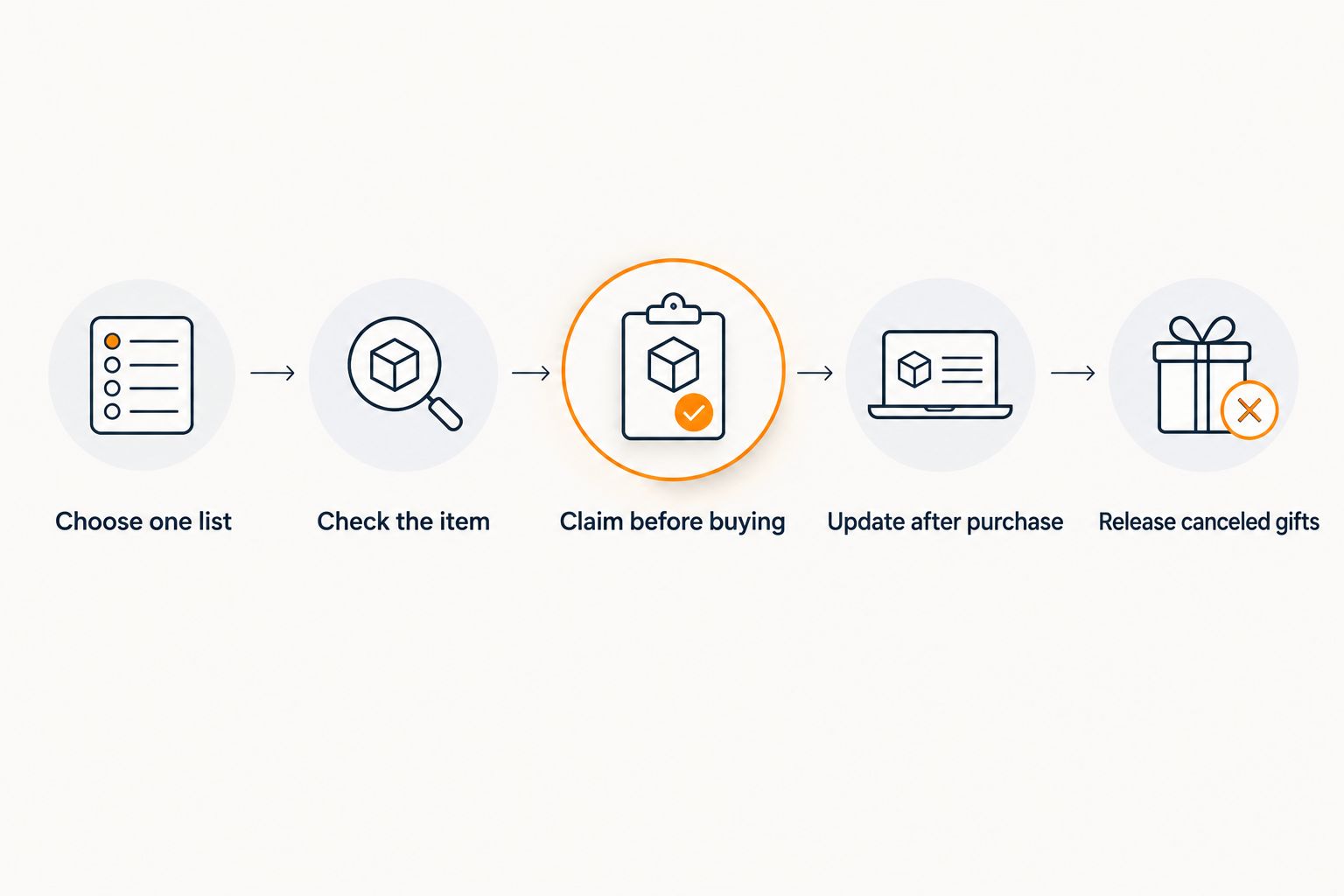
Send the workflow with your 2026 invitation. Buyers should not have to guess whether they should reserve first, report a purchase afterward, or message someone separately.
Why duplicate-gift prevention varies
The same wishlist can work well for one group and poorly for another. The difference is how clearly the purchase process answers these questions:
- Where is the current list? Old screenshots and copied product links leave buyers working from different information.
- When is an item claimed? A purchase update after checkout leaves a gap while another buyer is deciding.
- Who can see the status? Buyers need enough information to avoid an already-chosen item without exposing unwanted surprises.
- What quantity is wanted? One gift and several identical gifts need different coordination.
- What happens when plans change? An abandoned reservation needs a way back into the available choices.
- Who handles off-list purchases? A gift bought outside the normal workflow still needs to reach the shared record.
A list is only as current as the information buyers put into it. Before your 2026 event, explain who updates that information and when.
Where does LMK fit into duplicate-gift prevention?
LMK is best for shoppers who want one cross-store wishlist with automatic price-drop alerts. Its wishlist and gift-registry service brings items from hundreds of stores into a single list, including retailers such as Amazon, Target, Walmart, and Etsy.
That addresses a useful part of gift planning: keeping requested items together instead of scattering them across retailer lists and messages. Buyers can work from the recipient's cross-store choices rather than trying to reconstruct them.
The distinction is purchase coordination. Cross-store organization and price-drop alerts do not, by themselves, tell another buyer that a gift is already claimed. Check the purchase-status and privacy controls you need before relying on any wishlist to prevent duplicates.
LMK's automatic price tracking supports shopping decisions, but an alert is not a reservation. The guide to getting notified when a wishlist item drops in price explains that separate shopping task.
For your 2026 gift list, use LMK for its cross-store wishlist and price tracking. Pair your list with a verified buyer-status workflow or a coordinator rather than assuming that consolidating items completes the job.
Can you prevent duplicates without spoiling the surprise?
Yes—buyers can coordinate separately from the recipient. The important requirement is that gift selection and purchase information stay in a buyer-only workflow when the group wants those details hidden.
Check visibility before inviting everyone. Do not assume that marking an item purchased automatically hides the buyer, the status, or the gift from the list owner.
The guide to hiding purchased items from the gift recipient addresses this privacy question. Choose your purchase process and your recipient-visibility rules together; solving only one leaves the other unresolved.
Can two people still buy the same gift?
Yes—2 buyers can still order the same gift if neither records a claim before checkout. That example is a coordination failure, not proof that sharing a wishlist is useless.
Ask each buyer to claim first and purchase second. If the app cannot reliably show that an item is already taken, route claims through a coordinator who confirms each choice.
Does shared editing prevent duplicate gifts?
No—shared editing and purchase coordination do different jobs. Letting someone add or remove gift ideas does not necessarily give buyers a way to reserve them.
Before choosing shared editing as your solution, separate permissions for changing the list from permissions for recording purchases. The guide to sharing and editing the same wishlist covers the collaboration question; your duplicate-gift workflow still needs a clear claim process.
FAQ
Can a wishlist app prevent duplicate gifts?
Yes—a wishlist app can help prevent duplicate gifts when buyers reserve items or mark purchases and everyone uses the same current list. A shared product link alone does not prevent competing purchases.
What's the best wishlist setup for avoiding duplicate gifts?
The best setup combines one current gift list with a clear claim-before-checkout process. Use verified reservation controls or a coordinator who confirms each buyer's choice.
Is reserving a gift the same as buying it?
No—reserving a gift records an intention to buy, while a purchased status records a completed order. Update the record after checkout and release the claim if your plans change.
Can I keep purchased gifts hidden from the recipient?
You can keep purchase details in a separate buyer-only coordination process. For in-app coordination, verify recipient visibility rather than assuming purchase statuses are hidden.
Does LMK put gifts from different stores on one wishlist?
Yes—LMK supports cross-store wishlists and gift registries with items from hundreds of stores. It also provides automatic price tracking and price-drop alerts.
Do price-drop alerts stop other people from buying my gift?
No—price-drop alerts report price changes, not buyer claims. Coordinate your purchase separately before ordering.
What if the recipient wants more than one identical item?
Record the requested quantity before buyers claim the item. If the recipient wants 2 units, the coordination record needs to distinguish a partial purchase from a completed request.
What should I do if I cancel a reserved gift?
Release the reservation or tell the gift coordinator immediately. An outdated claim can discourage another buyer from choosing a gift that nobody is actually purchasing.
One last thing
The moment that matters is before checkout. After an order is placed, a purchase update helps later buyers, but it cannot undo a duplicate order already submitted.
Give your group one short instruction: check, claim, then buy. A wishlist makes the requested gifts visible; a clear purchase process makes the buyers' decisions visible to each other.