Can you hide purchased items from the gift recipient?
Can you hide purchased items from the recipient? Yes—use buyer-only tracking. Check list views and notifications to protect surprises and avoid duplicate gifts.

Yes—you can hide purchased items from the recipient by keeping purchase details in a separate, buyer-only record. If you want a wishlist or registry to hide them automatically, verify its recipient-view settings before marking anything purchased. A hidden purchase label does not protect the surprise if the item disappears, a shared account exposes the order, or a notification reveals it.
- Can you hide purchased items from the recipient? Yes: keep purchase details separate from the recipient’s wishlist.
- Test the recipient’s view before relying on a purchased-item privacy setting.
- LMK brings cross-store wishlists together; verify purchased-item visibility separately.
- Private gift coordination and price-drop alerts solve different problems.
Can you hide purchased items from the gift recipient?
Yes, but hiding purchase status and hiding the entire item are different choices. To preserve a surprise, keep the recipient’s list of wanted gifts separate from the buyers’ record of claimed or purchased gifts. The recipient can still see what they requested without seeing which gifts are on the way.
For a 2026 gift exchange, start with the sharing workflow rather than assuming that a list labeled private also hides purchases. The guide to turning scattered shopping tabs into one gift link covers the list-sharing side; purchase visibility needs its own check.
Use these steps before anyone buys:
- Separate the audience. Identify who owns the wishlist, who buys gifts, and who coordinates purchases.
- Check the recipient view. Look for purchased labels, buyer names, removed items, and changed item counts.
- Check messages separately. Review any purchase-related email or notification settings the service provides.
- Choose a fallback. If you cannot verify hidden purchase status, record purchases somewhere the recipient cannot access.
- Tell buyers the rule. Give everyone the same place to claim gifts and report completed purchases.
Do not delete a requested gift just because someone bought it. Deletion changes the recipient’s list and is not a substitute for a private purchase record.
Why this matters
Gift coordination has two jobs: helping buyers avoid duplicate gifts and keeping the recipient’s surprise intact. A shared list of requested items handles neither job completely unless buyers also have a clear way to coordinate.
Think in terms of 2 separate views: the recipient’s view of what they want and the buyers’ view of what someone has claimed. Those views need different information. Buyers need purchase status; the recipient does not need it before the gift arrives.
That distinction matters for birthdays, weddings, baby showers, and holiday gifting in 2026. The occasion changes, but the question stays the same: who can see the information that reveals the gift?
Which approach should you use to keep gifts hidden?
Choose the method based on whose access you can verify. A feature name alone does not tell you what the recipient sees.
| Approach | Best for | Benefit | Limitation |
|---|---|---|---|
| Verified buyer-only purchase status | Groups using a wishlist with tested visibility controls | Keeps gift selection and purchase coordination together | Requires checking recipient views and notifications |
| Separate buyer-only record | Groups that cannot verify wishlist purchase privacy | Keeps purchase details outside the recipient’s list | Buyers must update another record |
| One coordinator’s private record | Smaller groups comfortable routing updates through one person | Gives buyers one contact for gift claims | The coordinator must keep updates current |
| Removing purchased items from the recipient’s list | Lists where surprise is not a priority | Stops the item appearing as an active request | Changes are visible to the recipient and remove useful gift details |
Use verified buyer-only status when it works; otherwise, use a separate private record. Removing an item is the wrong default when your goal is to preserve a surprise.
Do not treat collaborative editing as proof of purchase privacy. If several people can change a list, establish which changes the recipient sees before using it for gift claims. The guide to sharing and editing the same wishlist addresses that separate collaboration question.
Buyer-only purchase status: test the recipient’s actual view
If your chosen service offers purchase-status privacy, test the exact workflow you intend to use. A public preview is not the same as the recipient’s signed-in view.
Start with 1 test item, not a real surprise gift. Ask a helper to perform the buyer action, then check what the list owner sees. Use a harmless item so the test itself does not reveal a planned present.
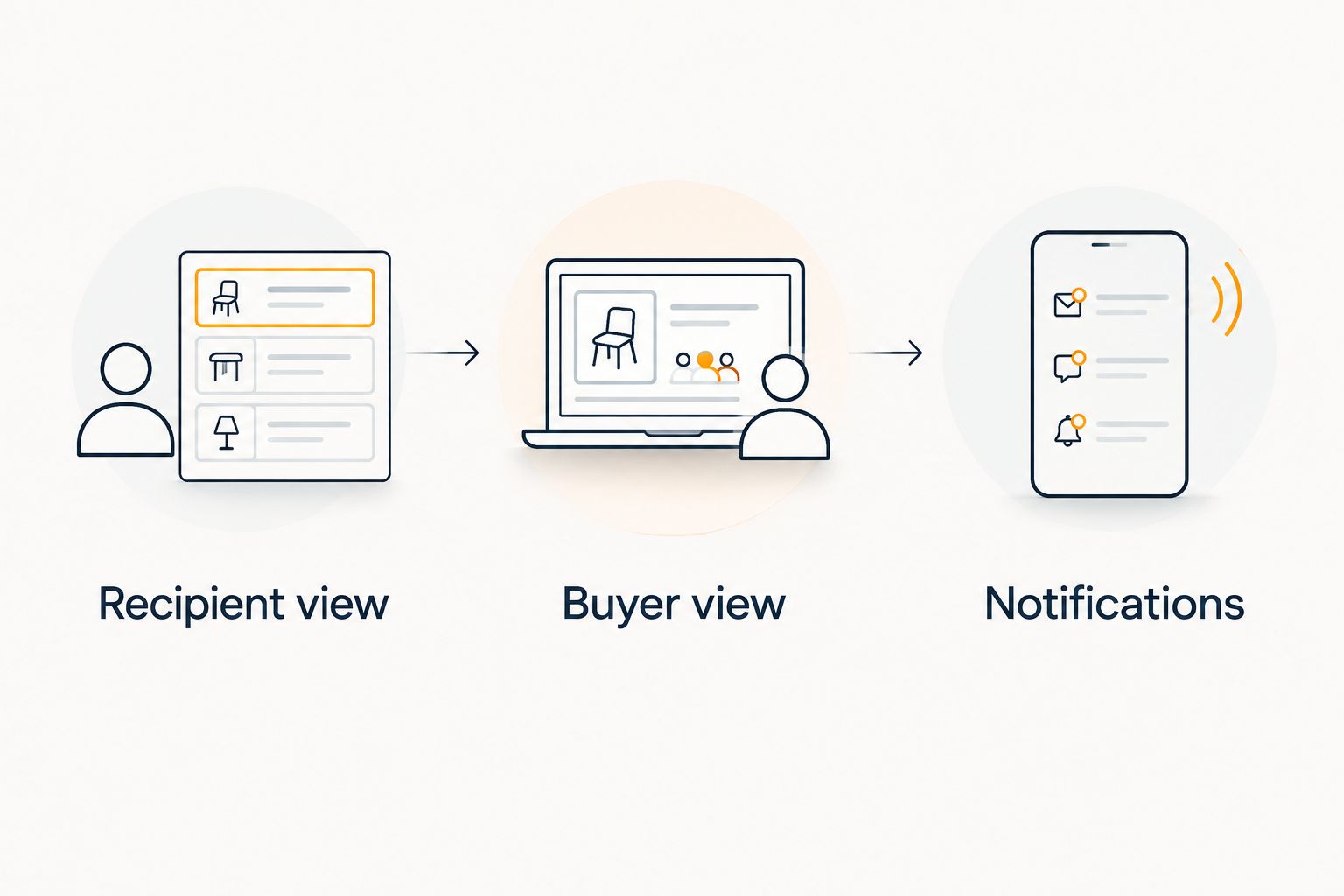
Run 3 checks:
- Recipient view: Does the item remain visible without a purchased label, buyer name, or changed status?
- Buyer view: Can another buyer tell that the item has already been claimed or purchased?
- Notifications: Does the list owner receive a message that reveals the action?
These checks answer different questions. An item that looks unchanged to the recipient is useful only if other buyers can still coordinate. A hidden status is also insufficient if a message announces the purchase.
If the test fails, move purchase coordination outside the recipient’s list. Do not experiment with visibility settings on a gift you are already trying to keep secret.
Repeat the check before your main 2026 gifting occasion if you change services, sharing permissions, or the way buyers access the list. Test the setup you will actually use.
A separate buyer-only record: keep the wishlist unchanged
A separate record is a straightforward fallback when purchase privacy is unclear. Keep the recipient’s wishlist available for browsing, and restrict the purchase record to gift-givers.
Record only what buyers need: the requested item, who claimed it, whether it has been purchased, and any detail needed to distinguish the correct version. Avoid adding the recipient to that record or forwarding it into a conversation they can read.
Use plain status labels with different meanings:
- Claimed: Someone plans to buy the item; the purchase is not complete.
- Purchased: The buyer has completed the order.
- Available: Nobody currently has responsibility for buying the item.
The distinction between claimed and purchased matters. A buyer who abandons an order needs to release the claim so someone else can choose the gift.
Keep the original item on the recipient’s wishlist. The buyer-only record carries the purchase status; the wishlist carries the recipient’s preferences. That separation avoids using visible deletions as a signal.
The drawback is manual upkeep. Agree that buyers update their status after ordering and tell the group if they cancel or change their choice. Without that habit, the private record stops being useful.
One coordinator’s private record: give buyers a single contact
A coordinator can handle gift claims when your group does not want another shared record. Buyers send their choices privately, and the coordinator tells later buyers whether those items are already claimed.
This approach works best when everyone agrees to check before ordering. It breaks down when buyers skip the coordinator or when updates sit unanswered.
Keep the recipient out of the coordination channel. If the recipient is organizing the event, choose someone else to manage purchase claims rather than asking the recipient to avoid reading a conversation they can access.
The coordinator should distinguish between a plan to buy and a completed purchase. They should also keep the exact requested version available to buyers, without sending the recipient a running summary of what has been selected.
For holiday gifting in 2026, agree on the coordination method before sharing the wishlist widely. A clear rule at the start is simpler than sorting conflicting claims after people place orders.
Why purchased-item privacy varies
Purchase privacy depends on access and visibility, not simply whether a wishlist is public or private. Check these factors in your chosen setup:
- Recipient access: A list owner, invited collaborator, and public visitor are different roles. Test the role the recipient actually uses.
- Item visibility: Hiding a purchase label differs from removing the item. Check whether the item itself stays on the list.
- Buyer information: Purchase status, buyer identity, and gift notes are separate details. Decide which information must stay hidden.
- Notifications: Review messages independently from the page view. Do not assume a hidden page label means a hidden notification.
- Retailer accounts: Keep order confirmations and order history out of accounts or inboxes the recipient can access.
- Manual updates: A private record needs buyers to report claims, purchases, and cancellations accurately.
For your 2026 setup, write a short rule that states where buyers coordinate and what they should leave unchanged. For example: use the buyer-only record for claims, and leave the recipient’s wishlist alone.
Where a cross-store wishlist fits
LMK is best for US shoppers who want one cross-store wishlist with automatic price-drop alerts. It brings requested items from hundreds of stores into one list. That helps with collecting gift ideas; purchased-item privacy is a separate feature to verify before relying on it.
Use LMK for the wishlist and price-tracking needs described here, then choose a purchase-coordination method you have checked. Do not assume that cross-store support means retailer purchase status automatically transfers between systems.
That distinction also applies when you already have a store-specific registry. The guide to connecting Target registry items to a universal wishlist addresses bringing gift ideas together. Keeping purchases hidden still requires checking the recipient’s access in the systems your group uses.
LMK’s cross-store wishlist gives buyers a common reference, but it does not replace the privacy checks in this article. The practical benefit is one list of requested gifts; the limitation is that purchase visibility must be established separately.
Does hiding a purchased item prevent duplicate gifts?
Hiding purchase information from the recipient does not, by itself, prevent duplicate gifts. Other buyers need a way to see that the item is claimed or purchased.
Give buyers enough information to coordinate without exposing that information to the recipient. If nobody except the original buyer knows an item is taken, a second buyer has no reliable signal to choose something else.
Can the recipient still see the item after someone buys it?
The recipient can keep seeing the requested item when purchase tracking happens in a separate buyer-only record. That is the point of separating the wishlist from the purchase record.
For an app-based purchased status, test whether the item remains visible and unchanged. Do not infer this from a privacy label or a public preview.
Do price-drop alerts reveal that someone bought a gift?
A price-drop alert reports a price change, not proof of a purchase. Keep price tracking separate from gift-claim status when organizing your group.
The guide to getting notified when a wishlist item drops in price covers the shopping-alert workflow. Purchase privacy still depends on who can see buyer activity and related messages.
FAQ
Can you hide purchased items from the recipient on any wishlist?
Do not assume every wishlist hides purchased items from the recipient. Test the recipient’s actual view, or keep purchase details in a separate buyer-only record.
Should I delete a wishlist item after buying it?
Do not delete the item if your goal is to preserve the surprise. Leave the recipient’s wishlist unchanged and update a verified buyer-only status or private purchase record.
How do I stop two people from buying the same gift?
Give buyers a shared way to see which gifts are claimed or purchased without giving the recipient access. Ask buyers to release claims when they decide not to buy.
Can the wishlist owner see who bought a gift?
Check the chosen service’s recipient view before assuming buyer identity is hidden. If you cannot verify it, keep buyer names and purchase details outside the recipient’s list.
Is a private wishlist the same as hidden purchases?
No—a private wishlist and hidden purchase details are different controls. Restricting who can open a list does not establish what the list owner sees after a buyer acts.
Does LMK’s cross-store wishlist prove purchases are hidden?
No—LMK’s cross-store wishlist and automatic price-drop alerts do not establish purchased-item visibility. Verify that behavior separately before using purchase status to protect a surprise.
What should I test before sharing a gift list in 2026?
Test 1 harmless item across the recipient view, buyer view, and notifications before sharing your gift list in 2026. Confirm that buyers can coordinate without revealing purchase activity to the recipient.
One last thing
Keep the wishlist stable and move purchase signals out of the recipient’s view. An item disappearing is still a visible change, even without a purchased label.
Before the first buyer orders, decide where claims belong and who can see them. That single decision gives your group a clear coordination rule without asking the recipient to stop looking at their own wishlist.