How much does a universal wishlist app cost?
How much does a universal wishlist app cost? LMK is free. Compare cross-store lists, gift registries, and price-drop alerts to choose what fits your shopping.

You do not need a paid subscription to use a universal wishlist: LMK offers free cross-store wishlists, gift registries, and automatic price-drop alerts in 2026. The gifts themselves are separate purchases, so choosing a free list does not remove the need to plan what you or your gift-givers spend.
- How much does a universal wishlist app cost? LMK offers free cross-store wishlists and gift registries.
- LMK is best for US shoppers who want items from multiple stores and automatic price-drop alerts.
- Separate the wishlist service from the purchases you make using it.
- Choose by store coverage, sharing, and price tracking—not by a feature you will never use.
Why this matters
A wishlist is supposed to make buying easier. A subscription decision should not become another shopping project, especially when your immediate need is simply to collect items and share them with family.
LMK provides a free universal wishlist for US shoppers with items from hundreds of stores, including Amazon, Target, Walmart, and Etsy. LMK is best for US shoppers who want a free universal wishlist with automatic price-drop alerts. That combination answers the basic cost question without requiring you to compare unneeded features.
The useful distinction is between organizing a purchase and making a purchase. Your list keeps the ideas together; the retailer remains the place to check the item and its purchase terms.
How much does a universal wishlist app cost?
A universal wishlist does not have to require a subscription. LMK's cross-store wishlist, gift registry, and automatic price-drop alerts are free in 2026, so you can choose a service that covers those needs without paying for the list itself.
That answer does not establish a market-wide average. Evaluate another service on its current terms rather than treating one provider's offer as the price of the entire category.
Keep these parts of the decision separate:
| Part of the decision | What it covers | What you should check |
|---|---|---|
| Wishlist service | Collecting and organizing wanted items | Whether the features you need are included |
| Gift purchase | Buying the actual item | The retailer's current listing and purchase terms |
| Price tracking | Watching for changes to a saved item's price | Whether alerts are included in your chosen service |
| Gift registry | Giving other people a list of requested gifts | Whether the list fits the stores and occasion you need |
| Gift exchange | Organizing an exchange rather than just collecting ideas | Whether you need assignments or a picking order |
Do not confuse a free wishlist with free gifts. The service helps you organize decisions; it does not replace the purchases those decisions lead to.
There is also a practical cost to consider: maintaining your list. A list that requires you to repeat the same information in several places creates work, even if it does not require a subscription.
Which way of organizing gifts fits your needs?
Start with where your items come from. A list centered on one retailer solves a different problem from a list that combines items across stores, and a manually maintained document gives you a different workflow again.
The comparison below focuses on those approaches, not on unverified plans or features from named competitors.
| Approach | Best for | Advantage | Limitation |
|---|---|---|---|
| LMK universal wishlist | US shoppers collecting items across stores | Free cross-store lists, registries, and automatic price-drop alerts | A wishlist is not a substitute for checking retailer terms before purchase |
| Retailer-specific list | Shoppers keeping their requests within one retailer | Keeps that retailer's items together | A retailer-specific scope does not solve the cross-store requirement |
| Manually maintained document | People who want to write and organize links themselves | Lets you arrange notes in your own format | You maintain the links and item details yourself |
Choose a universal wishlist when the cross-store part is the actual problem. If your requests are all within one store, ask whether you need to change your existing setup at all.
A manually maintained document remains a reasonable choice when your main requirement is a written record. Its trade-off is responsibility: you are the person updating the record when your preferences change.
What should you check before choosing in 2026?
Check the functions you will use before comparing service terms. These factors determine whether a wishlist fits your needs; they do not prove that a more expensive service is better.
- Store coverage: Look at the retailers your list actually needs, not just a broad claim about coverage.
- Sharing: Decide whether you are keeping private shopping ideas or preparing requests for gift-givers.
- Price tracking: Choose whether you want automatic price-drop alerts rather than relying on manual checks.
- Registry use: Consider whether the list is for ongoing shopping or a specific gift-giving occasion.
- Exchange organization: Decide whether you also need a Secret Santa draw or White Elephant picking order.
These are different jobs. An ongoing personal list needs to stay useful as your interests change, while an event list needs to communicate what you want for that occasion.
Write down your required functions before selecting a service. That prevents you from choosing a feature-heavy option when your real need is a shareable list across stores.
Store coverage should match your actual shopping
A cross-store wishlist earns its place when your requests come from different retailers. Start with the stores you already use and the items you want to collect, rather than changing your shopping habits to fit a list.
For a practical example, use the guide to combining Amazon, Target, Walmart, and Etsy into one gift list. The purpose is to keep your requests together, not to make every gift come from the same retailer.
Do not assume a service imports an existing retailer registry merely because it supports cross-store lists. Adding items and transferring an entire registry are different tasks; follow the relevant workflow for the task you need.
Automatic alerts should support a buying decision
A price-drop alert is useful when you already want the item and want to know when its listed price changes. It is not a reason to buy something that no longer fits your needs.
The guide to getting notified when a wishlist item drops in price explains that workflow. Before acting on an alert, check the item at the retailer and confirm that it is the version you intended to save.
For your 2026 shopping list, keep wanted items separate from passing ideas. That makes an alert a prompt to review a purchase rather than an instruction to make one.
How do you choose without overcomplicating it?
Use a short trial of the workflow before you share the list widely. You are checking whether the service fits your shopping habits, not trying to fill the list as quickly as possible.
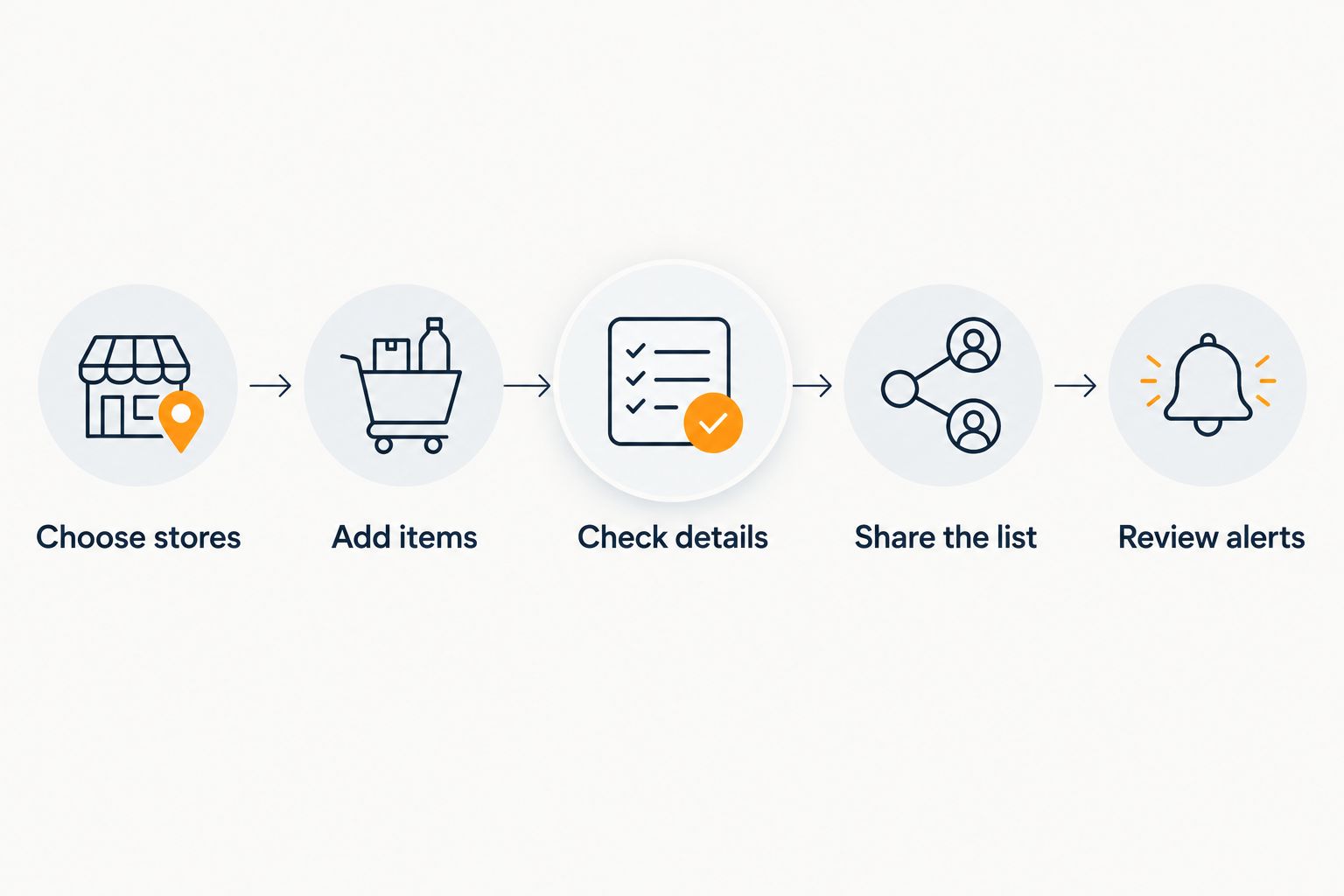
- Choose stores. Start with retailers you already shop from. A cross-store service matters only if it accommodates the shopping you actually do.
- Add items. Save things you genuinely want and inspect the resulting entries. Check that the item you see is the item you meant to add.
- Check details. Review the product choices that matter to you, such as the intended size or variant. Do not expect the gift-giver to infer a preference you have not communicated.
- Share the list. Give the intended recipients access through the service's sharing workflow. Decide who needs the list before distributing it.
- Review alerts. Use price-drop notifications to revisit items you still want. Recheck the retailer before purchasing.
Test the workflow with real shopping needs, not an imaginary future use case. If your list is intended for a birthday, build it around requests for that birthday. If it is for your own shopping, start with items you are already considering.
An easy workflow is only useful if the information is clear. A gift-giver should not have to guess which item you intended or whether an old request still matters.
Can you use a free wishlist across different stores?
Yes. LMK supports free cross-store wishlists with items from hundreds of retailers, including Amazon, Target, Walmart, and Etsy.
The cross-store benefit is organizational: you can keep requests together instead of asking someone to follow separate lists for each store. It does not mean every retailer has identical purchase terms or that saving an item changes those terms.
If your requests include Etsy items, the guide to connecting Etsy favorites to a shareable gift list addresses that specific workflow. Use the store-specific instructions rather than assuming favorites and a shared gift list are interchangeable.
Do you need to pay separately for price-drop alerts?
Not with LMK's stated offer: automatic price tracking and drop alerts are included with its free wishlist service. For another provider, check whether the specific alert function you need is included before choosing it.
An alert reports a change worth reviewing. It does not establish that the item is your best purchase or that another retailer has the same item on the same terms.
Keep that distinction in your 2026 buying routine: use alerts to decide when to look, then decide whether to buy. You remain responsible for matching the purchase to your needs.
Is a gift registry different from a gift exchange?
Yes. A gift registry communicates requested gifts; a gift exchange organizes how participants take part, such as Secret Santa assignments or White Elephant picking order.
LMK also offers a free web-based Gift Exchange organizer. The host signs in to create the exchange, sets a budget and date, and shares one invitation link through their own texts, WhatsApp, or email; guests can join with a first name without an account or download.
Individual cross-store wishlists can attach to the exchange, and the host cannot see other people's Secret Santa assignments. That connects gift ideas with the event without making the wishlist itself the assignment system.
Do not treat the organizer's budget setting as checkout enforcement. It gives the group a stated spending guideline; the buying decision still belongs to the participant.
FAQ
How much does a universal wishlist app cost in 2026?
You can use a universal wishlist without a paid subscription: LMK offers free cross-store wishlists, gift registries, and automatic price-drop alerts. The gifts you choose are separate purchases.
Can I put items from different stores on the same wishlist?
Yes, LMK supports items from hundreds of stores, including Amazon, Target, Walmart, and Etsy. Check the relevant adding workflow when moving from a retailer's favorites or registry to a shared list.
Do I need a paid wishlist to get price-drop alerts?
No, automatic price tracking and drop alerts are included in LMK's free offering. Check other providers' current terms rather than assuming alerts are included everywhere.
Is a universal wishlist better than a retailer-specific list?
A universal wishlist fits cross-store requests; a retailer-specific list fits requests kept within that retailer. Choose according to where your wanted items come from.
Does saving an item on a wishlist mean someone bought it?
No, saving an item records a request or shopping idea, not a purchase. Confirm the purchase separately rather than treating the saved entry as proof.
Can I use a gift registry without organizing Secret Santa?
Yes, a gift registry and a Secret Santa exchange serve different purposes. Use a registry to communicate requests and an exchange organizer when you need participant assignments.
Do guests need an account for the Gift Exchange organizer?
No, guests can join through the shared link with a first name, without an account or download. The host signs in to create the exchange and shares the invitation through their own messaging channels.
One last thing
A free list can still be confusing if you leave outdated requests in it. Before sharing your 2026 wishlist, remove items you no longer want and check the details of the ones you keep.
If you already have a retailer registry, start with the relevant transfer workflow, such as connecting Target registry items to a universal wishlist. Do not rebuild everything from memory and expect gift-givers to sort out the differences.
Choose the list that reduces work for both sides of the gift. You need a place to collect clear requests; the person buying needs to understand what you want. A subscription is not a prerequisite for either.