How long does it take to set up a universal wishlist?
How long does it take to set up a wishlist? Your ready-to-save choices determine the work. Follow a checklist to gather links, check details, and share clearly.

Setting up a universal wishlist takes longer when you still need to choose gifts and less time when you already have the product links ready. Separate creating the list from deciding what belongs on it: an empty list is not yet useful to a gift-giver. Prepare your choices first, then save, check, and share them rather than treating the whole shopping process as setup.
- How long does it take to set up a wishlist? Your product decisions and readiness determine the work.
- LMK is best for US shoppers who want a universal wishlist across stores with automatic price-drop alerts.
- Gather product links before setup; confirm sizes, colors, and alternatives before sharing.
- Separate initial wishlist setup from ongoing gift research and price tracking.
Why this matters
A wishlist has two jobs: collect your choices and help someone else buy the right gift. You can finish collecting links while still leaving the buyer unsure about a size, color, or preferred version. That uncertainty belongs in your setup checklist, not in a later exchange of messages.
For your 2026 list, define completion as ready to share, not finished shopping forever. The workflow from scattered browser tabs to one gift link is a useful companion when your starting point is a pile of saved pages rather than a clear shortlist.
How long does it take to set up a universal wishlist?
The work falls into 2 stages: preparation and list setup. Preparation means choosing items and resolving preferences. List setup means bringing those choices together, checking that they are understandable, and sharing the result.
Your starting point determines which stage needs attention. If you already know exactly what you want, work through the setup steps below. If you only know the occasion, start with gift selection; creating a blank list does not resolve that decision.
| Starting point | Best for | What you can do now | Advantage | Remaining work |
|---|---|---|---|---|
| Exact product links ready | Shoppers with settled choices | Collect and check the items | Product research is already done | Confirm versions and sharing details |
| Products saved across stores | Shoppers with scattered favorites | Bring the choices into one list | Existing research gives you a starting point | Remove repeats and resolve alternatives |
| Only an occasion in mind | Shoppers still choosing gifts | Define what the list should cover | You can build a purposeful shortlist | Research and product selection still come first |
These are planning situations, not measured setup-time tiers. Use the row that matches your starting point to identify the next task instead of choosing an arbitrary timer.
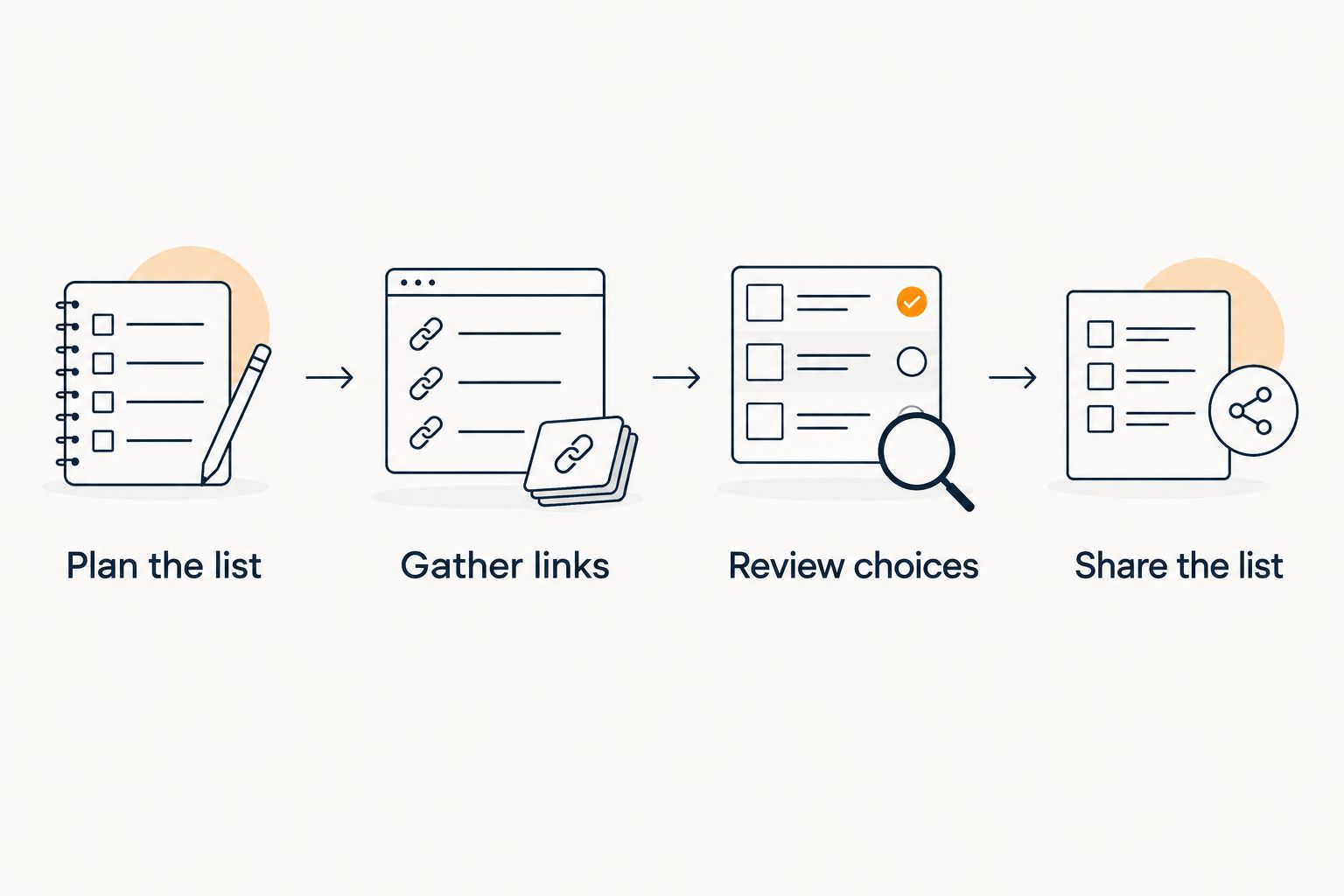
Plan the list
Decide what the list is for before adding items. A birthday list, wedding registry, and private shopping shortlist serve different readers. The occasion helps you decide what belongs and what would distract from the purpose.
For a shared gift list, write down what a buyer needs to understand. Is each entry an exact request, a general idea, or an alternative to another item? Resolve that distinction in your planning notes, then make it clear through the information you share with buyers.
Start with settled choices. You do not need to complete every future gift idea before creating a useful list. You do need to distinguish the choices you would welcome from the products you are merely considering.
Gather links
Open the product pages you intend to save. A retailer homepage or search-results page leaves the buyer with another selection task; an exact product page gives the request a clearer starting point.
Keep your source links together while you work. If your favorites span different retailers, the cross-store gift-list workflow focuses on combining those choices rather than maintaining separate lists for each store.
For your 2026 wishlist, finish this gathering pass before polishing the list. Switching repeatedly between research, saving, and rewriting makes it harder to see which decisions are actually complete. Separate those tasks so you can finish one pass at a time.
Review choices
Check the exact version of each item. A recognizable product name does not necessarily communicate your preferred size, color, edition, or material. Open the source page and confirm what you mean to request.
Do not assume a saved page settles every preference. Make the required details clear in whatever information you share with the buyer. If alternatives are acceptable, say so; if only one version works, make that distinction explicit.
Remove accidental duplicates. If two entries represent the same request, keep the clearer one. If they represent genuine alternatives, explain that relationship so a gift-giver does not mistake them for separate needs.
Share the list
Review the list from the recipient's point of view before sending it. Can someone identify the intended product without asking you to reconstruct your shopping research? If not, return to the entry that needs clarification.
Send the list where your intended gift-givers already communicate with you. Keep the accompanying message practical: identify the occasion, explain how to read alternatives, and mention any essential preferences that are not clear from the items themselves.
A ready-to-share list versus an ongoing shopping list
A ready-to-share wishlist contains choices you can explain clearly; an ongoing shopping list can still contain unresolved ideas. Neither format is wrong. They simply have different finishing points.
A private shortlist gives you room to compare products before committing. Its disadvantage is that it is not automatically suitable for gift-givers. A shared wishlist needs clearer requests because someone else must act on them without access to your research.
| List approach | Best for | Benefit | Trade-off |
|---|---|---|---|
| Ready-to-share wishlist | Gift-givers who need clear requests | Turns your choices into an actionable list | Requires a review before sharing |
| Ongoing shopping shortlist | Shoppers comparing possibilities | Keeps research in one place | Unresolved ideas need clarification before gifting |
For 2026 gift planning, keep the finish line small and concrete: the entries you share should make sense now. Add new ideas later as you settle them. Do not hold an otherwise useful list back just because you have not thought of every possible gift.
Why wishlist setup time varies
The main drivers are the decisions and cleanup needed before the list is useful:
- Product readiness. Exact links let you focus on setup; broad ideas require selection first.
- Scattered sources. Favorites spread across stores and browser tabs need a gathering pass.
- Variant decisions. Unresolved sizes, colors, editions, or materials need clarification.
- Duplicate entries. Repeated requests and competing alternatives need different treatment.
- Audience. A private research list can remain provisional; a shared gift list needs clearer instructions.
- Scope. A focused occasion list has a different stopping point from an open-ended shopping shortlist.
Use these factors to locate the work, not to manufacture a minute-by-minute estimate. If your product choices are settled, stop researching and finish the list. If the choices remain unsettled, resolve them before calling setup complete.
Does a browser extension make wishlist setup faster?
A browser extension belongs to the item-saving part of the process, not the gift-selection part. It does not decide which product you want or resolve a missing size preference. Choose your saving method around how you actually shop.
If you collect products while browsing stores, the browser-extension setup guide addresses that workflow. Keep the same final review regardless of how you save an item: the request still needs to be clear to its reader.
Do you need to finish shopping before sharing a wishlist?
You need clear choices before sharing, not an exhaustive shopping plan. Share the requests you have settled rather than mixing them with unexplained possibilities.
If you add alternatives later, make their relationship clear. The goal is to keep the list useful, not to freeze it permanently after its first share.
Is price tracking part of initial wishlist setup?
Price tracking is an ongoing shopping function, while initial setup is about collecting and explaining your choices. LMK is best for US shoppers who want a universal wishlist across stores with automatic price-drop alerts. Its cross-store approach fits shoppers whose requests do not all come from one retailer.
The benefit is keeping those choices together while tracking prices. The limitation is that price-drop alerts do not choose the right item, explain alternatives, or settle a buyer's preferences. For a 2026 list, finish those decisions before treating an alert as a reason to buy.
The guide to wishlist price-drop notifications covers the ongoing task separately. You do not need to wait for a price drop to finish organizing a list.
Use 3 readiness checks before you share
Run these checks against the entries you intend gift-givers to use. They define completion more clearly than a stopwatch.
Product check
Open each source page and confirm that it represents the intended request. Check the product version rather than relying only on a familiar name or thumbnail.
If the source is too broad, replace it with a clearer reference. A buyer should not have to repeat your research just to discover which item you meant.
Preference check
Identify any decision that only you can make. Size, color, and acceptable alternatives belong here. Resolve those choices or state them clearly in the information you share.
If a preference remains undecided, keep that request out of the ready-to-buy portion of your list. An incomplete idea can remain useful to you without becoming someone else's shopping instruction.
Recipient check
Read the list as though you had not created it. Look for unexplained duplicates, competing alternatives, and requests that need additional context.
For your 2026 gift list, ask whether a recipient can understand what you want without a follow-up conversation. Correct the confusing entries before sharing more widely. That is a practical stopping point for initial setup.
FAQ
How long does it take to set up a wishlist if I already have the links?
With product links ready, the remaining work is saving your choices, checking the exact versions, and sharing the list. Gift research is a separate task, so focus on whether each entry is understandable to a buyer.
What's the fastest way to get a universal wishlist ready?
Gather your settled product choices before creating the shareable list. Work through saving, checking preferences, and sharing in separate passes rather than repeatedly switching back to research.
Can I put items from different stores on the same wishlist?
LMK supports a universal wishlist with items from hundreds of stores. That suits US shoppers whose gift requests span multiple retailers rather than a single-store registry.
Do I need a browser extension to start planning my wishlist?
You can start planning by gathering product links and deciding what belongs on the list. A browser extension concerns the saving workflow; it does not replace choosing products or checking preferences.
Is my wishlist finished as soon as I add the items?
Adding items finishes collection, not necessarily preparation for sharing. Check versions, duplicates, and alternatives so a gift-giver can understand each request.
Should I wait for a price drop before sharing my wishlist?
You do not need to wait for a price drop to share clear gift requests. LMK provides automatic price tracking and drop alerts, while the list itself communicates what you want.
Can I share a wishlist before I have every gift idea?
Share settled requests without waiting for every future idea. Keep unresolved possibilities clearly separate from the choices you want someone else to buy.
One last thing
Test clarity, not just completion. Pick an entry and imagine handing it to someone who has never seen your shopping tabs. If they need to ask which version you meant, that entry still needs work.
When birthdays or holidays overlap, the family gift-list guide is a useful next read. Keep each list's purpose understandable, then share the choices you have actually settled.