How do you split the cost of a gift with a group?
Learn how to split the cost of a gift with a group fairly. Agree on equal or voluntary shares, collect payments, include agreed extras, and settle the receipt.

Split a group gift by agreeing on the contribution rule before anyone buys, confirming who is participating, and dividing the final approved total among those contributors. Use equal shares when everyone agrees to the same amount; use voluntary contributions when budgets differ. Include agreed extras such as tax, shipping, and wrapping, and name one person to collect payments, make the purchase, and settle any difference.
- How to split the cost of a gift with a group: agree on contributions before buying, then reconcile the receipt.
- Equal shares suit matching budgets; voluntary contributions let friends participate without committing to the same amount.
- LMK is best for group gift shoppers who want cross-store wishlists and automatic price-drop alerts.
- Keep gift selection, payment collection, and the final receipt separate so everyone knows what they owe.
Why this matters
A group gift needs two agreements: what you are buying and what each person is willing to contribute. Settling only the first leaves the buyer responsible for chasing payments or covering an unexpected gap.
For your 2026 gift plans, confirm contributions before placing the order. A shared list helps with selection, but it does not replace an agreement about money. If you are still choosing the present, start with the practical questions behind group gift wishlists for friends: what the recipient wants, which item the group supports, and who will make the purchase.
How do you split the cost of a gift with a group?
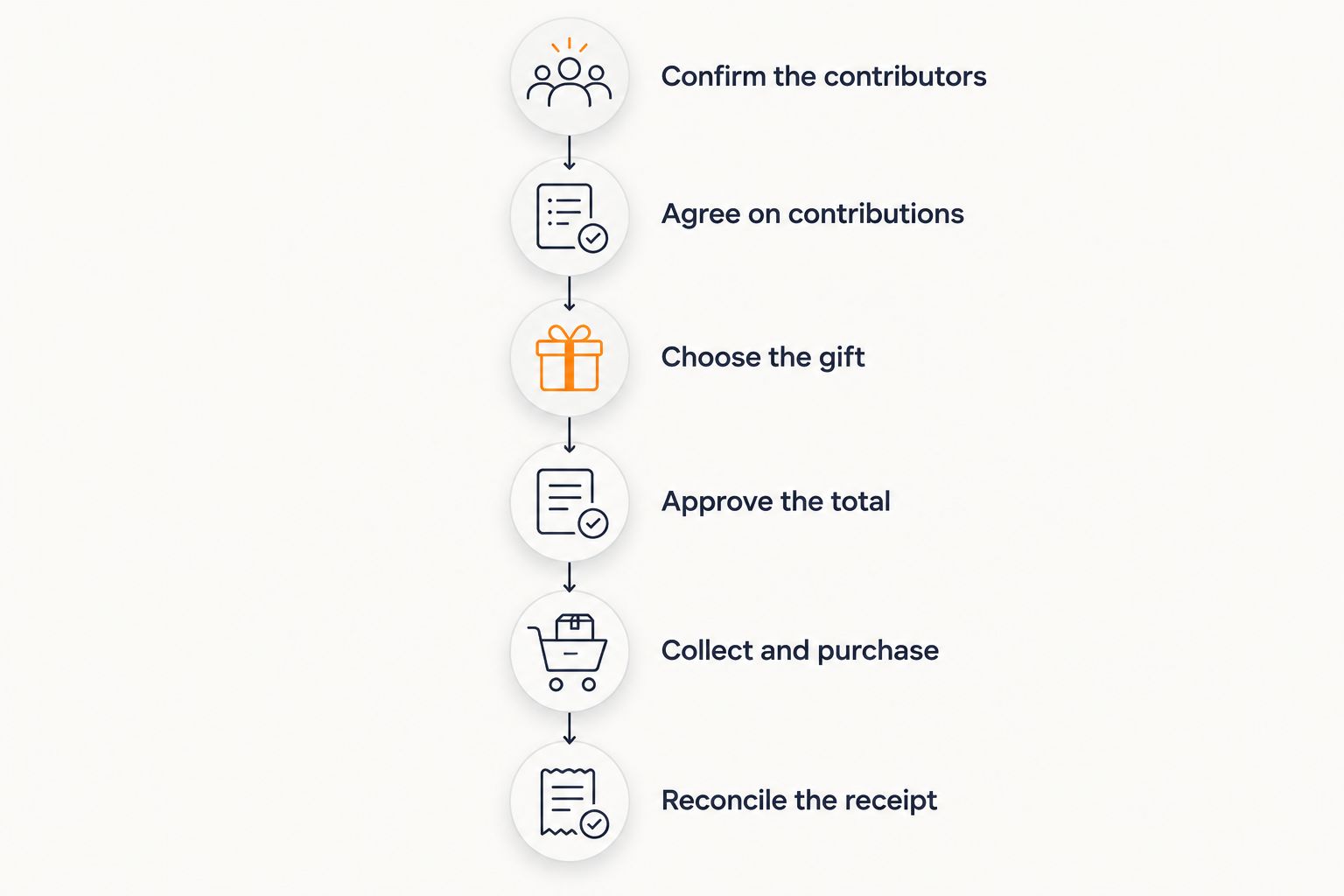
Use this sequence to turn a group chat into a clear purchase plan. Keep the decisions in one message thread or shared record so nobody has to reconstruct the agreement later.
Confirm the contributors
Ask who wants to participate before calculating anyone’s share. An invitation is not a commitment, and silence is not permission to include someone in the split.
Give people a way to decline privately. In a workplace or family group, that avoids turning a gift into a public test of generosity. Calculate the split using confirmed contributors, not everyone who received the message.
Agree on contributions
Choose equal shares or voluntary contributions before selecting the final gift. With equal shares, everyone accepts the same contribution rule. With voluntary contributions, each person chooses an amount privately and the group shops within the confirmed total.
Do not announce an equal split and quietly let some people pay less while expecting others to cover the difference. If contributions change, revise the agreement openly without revealing anyone’s private financial circumstances.
Choose the gift
Confirm the exact item, including any size, color, personalization, or other detail that affects the order. Someone liking a general idea is not the same as approving the item you plan to buy.
Name one buyer. Everyone else should contribute through the agreed process rather than ordering independently. That keeps a coordinated gift from becoming several duplicate purchases.
Approve the total
Check the checkout total before collecting the final payment. Include only the extras the group has agreed to cover, such as delivery or wrapping.
Write down both the spending ceiling and what it includes. The distinction matters when you set a spending limit on a group gift list: a shopping target and an agreement to reimburse expenses are different decisions. If the order exceeds the approved ceiling, pause rather than assuming everyone will accept the increase.
Collect and purchase
Tell contributors who receives the payments, which payment method to use, and when payment is due. Keep a simple record of confirmed contributions and payments received.
Do not treat promised money as collected money. If you buy before everyone pays, you are choosing to cover the temporary shortfall. Make that choice explicitly, or wait until the agreed contributions arrive.
Reconcile the receipt
After purchasing, share the final total with contributors and compare it with the amount collected. Return any excess or get agreement before putting it toward another expense.
Keep the receipt with the purchase record. If the order changes or the gift is returned, the same record tells you how to allocate the refund without reopening the original discussion.
Equal shares: best for matching budgets
An equal split means dividing the approved final total by the number of confirmed contributors. It is the simplest option when everyone agrees to the same financial commitment.
The advantage is clarity: everyone follows the same calculation. The drawback is that equal contributions do not necessarily feel equally affordable. Ask for agreement privately before presenting an equal split as settled.
If the division produces fractional cents, explain how you will handle the rounding. Do not collect an unexplained surplus just because the calculation is inconvenient.
Voluntary contributions: best for different budgets
Voluntary contributions let each person decide what they can give. Choose the gift after the commitments are confirmed, rather than choosing an item and pressuring the group to fund it.
This approach protects individual budgets, but it requires the organizer to track different contributions. Decide what happens if the total falls short: choose a different gift, invite an explicitly voluntary top-up, or cancel the purchase. Nobody should discover afterward that they were expected to cover the gap.
Which group gift split should you choose?
Use the payment rule that fits your contributors, not the one that makes the organizer’s first message shortest. For a 2026 office, family, or friend-group gift, the important distinction is whether everyone accepts the same commitment.
| Method | Best for | Advantage | Trade-off | Agreement needed |
|---|---|---|---|---|
| Equal shares | Contributors comfortable with the same commitment | Simple calculation and payment record | The same share can strain different budgets | Everyone approves the contribution rule |
| Voluntary contributions | Groups with different budgets | Each person controls their commitment | The gift depends on the confirmed total | Contributions stay private and the gift fits the total |
| Organizer covers extras | An organizer who explicitly wants to contribute more | Other contributors have a clear ceiling | The organizer takes responsibility for extra spending | State which expenses the organizer will cover |
Choose equal shares for simplicity, voluntary contributions for flexibility. Organizer-covered extras are appropriate only when the organizer offers; they are not a default obligation.
Why the amount each person contributes varies
The split depends on the purchase and the agreement, not just the item you initially selected. Check these factors before asking for payment:
- Confirmed contributors: changing the participant list changes an equal share.
- Contribution method: equal shares and voluntary contributions allocate the total differently.
- Final checkout total: include applicable tax and agreed delivery charges.
- Optional extras: wrapping and personalization belong in the split only when approved.
- Purchase changes: a replacement item or cancellation requires a revised record.
- Organizer contribution: an explicit offer to cover extras changes what everyone else owes.
A lower final total is not permission to add another gift. Settle the original agreement first, then ask whether contributors want to fund anything else.
Should everyone pay the same amount for a group gift?
Everyone should pay the same amount only when all contributors agree to an equal split. Fairness starts with consent, not identical payments.
For your 2026 group gift, ask about the contribution rule before discussing individual amounts in public. If someone needs a different arrangement, switch to voluntary contributions or let them opt out without explanation.
Should you collect the money before buying the gift?
Collect the money before buying when you do not want to cover unpaid contributions yourself. Waiting also gives you a confirmed spending ceiling instead of a total based on promises.
Buying first is a separate decision. If you choose it, state the reimbursement agreement before ordering and be prepared to handle a delayed payment without involving the recipient.
How do you keep unequal contributions private?
Keep unequal contributions private by recording individual amounts with the organizer rather than posting them in the group chat. Share the purchase decision and overall status without publishing a contribution ranking.
Do not tie names on the card to how much someone paid. Agree on how contributors will be acknowledged before collecting money, especially when colleagues or relatives have different budgets.
Keep gift selection separate from payment collection
Use a wishlist to identify the gift, then use your payment record to manage contributions. Combining those jobs in a long chat makes it harder to tell whether an item is merely suggested, approved, or already ordered.
LMK is best for group gift shoppers who want cross-store wishlists and automatic price-drop alerts. You can keep items from different retailers on one wishlist rather than asking contributors to compare scattered links. The limitation for this task is procedural: a wishlist and a price alert are not proof that everyone has agreed to contribute or has paid.
When your options span retailers, combining Amazon, Target, Walmart, and Etsy into one gift list keeps the selection discussion focused. Record the approved item separately so a later addition to the list does not look like a change to the purchase agreement.
For purchases you are planning in 2026, decide who watches the item and who has authority to order. An alert should trigger a checkout check, not an automatic decision to spend the group’s money.
Choose a payment method that fits the collection
Before sending payment instructions, check the service’s transfer limits, fees, and recipient details. Verify those details in the service itself rather than relying on an old message or screenshot.
The organizer’s collection depends on each contributor being able to send the agreed payment; money transfer app limits therefore belong in the planning check, before people commit to a collection method. Do not assume a payment service can accept the full collection merely because someone already uses it.
Keep the instructions specific:
- Identify the person collecting the money.
- Confirm the destination privately if it contains personal information.
- State the payment deadline and an identifying payment note.
- Explain whether any transfer fee is the sender’s responsibility or an approved shared expense.
- Confirm receipt in your contribution record.
Mark a contribution as received only after you verify the payment. A message saying it was sent is a status update, not a completed reconciliation.
What should you do if someone drops out?
If someone drops out before the purchase, recalculate the plan with the remaining contributors. Ask for approval before increasing anyone’s share.
Your choices are straightforward: select a different gift, accept a voluntary additional contribution, or stop the purchase. Do not divide the missing contribution among everyone else without asking.
If someone withdraws after the order, refer to the agreement made before buying. Keep the discussion between the organizer and contributors. The recipient should not have to resolve a payment dispute attached to their gift.
For a 2026 group purchase, a short written agreement is easier to use than a collection of assumptions. It should identify the contribution rule, approved expenses, buyer, and response to a shortfall.
How should you handle a lower total or a refund?
Compare the receipt with the collected amount before distributing any difference. For equal shares, return the excess according to the same equal-share rule. For voluntary contributions, agree on proportional refunds or another clear rule before buying.
LMK price-drop alerts support the shopping decision, but the final receipt controls the settlement. When you get notified that a wishlist item drops in price, check the complete checkout total before revising what contributors owe.
Do not promise an immediate refund before the retailer has returned the money. Keep contributors informed about the status and distinguish a requested refund from money actually received.
Send one clear purchase message
Before placing the order, send a short summary everyone can approve. Use this structure without turning it into a public list of individual finances:
- Gift: the exact agreed item and recipient.
- Contributions: equal shares or privately agreed voluntary amounts.
- Expenses: what the shared total includes.
- Buyer: who will place the order and keep the receipt.
- Deadline: when contributions are due.
- Changes: what happens if the total changes or someone withdraws.
Keep the message factual. Avoid language suggesting that participation is expected because everyone else has joined. A clear invitation gives people enough information to say yes—or decline—without an uncomfortable follow-up.
FAQ
What's the fairest way to split a gift with friends?
The fairest split is the one contributors agree to before the purchase. Use equal shares when everyone accepts the same commitment, or private voluntary contributions when budgets differ.
How do I calculate each person's share of a group gift?
Divide the approved final total by the number of confirmed contributors for an equal split. Include only agreed expenses and explain any rounding before collecting payment.
Should tax and shipping be included in a group gift split?
Include applicable tax and shipping when the group has agreed to share those expenses. Confirm the checkout total so contributors are not surprised by an additional payment request.
Is it rude to ask for money before buying a group gift?
Asking for agreed contributions before buying gives the group a confirmed spending ceiling. Make participation optional and explain the collection deadline before anyone commits.
What if someone cannot afford an equal share?
Offer private voluntary contributions or let the person decline without explanation. Do not publish individual contribution amounts or pressure the person to justify their budget.
Can LMK help organize the gift choices?
LMK lets gift shoppers create cross-store wishlists and receive automatic price-drop alerts. Keep contribution commitments, payment receipts, and the final settlement in a separate record.
What happens to leftover group gift money?
Return leftover money according to the contribution rule unless everyone agrees to another use. Do not spend the remainder on wrapping or an additional gift without approval.
One last thing
The most useful group gift record is not a list of promises. It is the agreed item, the contribution rule, the payments received, and the final receipt.
Keep those together through delivery and any return. The workflow from scattered browser tabs to one gift link addresses the selection side; your payment record completes the money side. Finish the settlement before treating the gift as finished.