Can you set a spending limit on a group gift list?
Can you set a spending limit on a group gift list? Yes—but it isn't checkout enforcement. Define the cap, tax, delivery, and shared contributions before buying.

Yes, you can set a spending limit for a group gift list by agreeing on a maximum and sharing it with everyone; some gift-exchange organizers also let the host record a budget. That budget communicates the rule—it does not stop someone from spending more at a retailer’s checkout. For your 2026 exchange, specify whether the limit applies to each giver’s total purchase or to a shared gift, and whether it includes tax and delivery.
- Can you set a spending limit on a group gift list? Yes—but a stated budget is not checkout enforcement.
- LMK lets gift-exchange hosts set a budget; cross-store wishlists help guests choose gifts.
- Define whether the spending limit covers one giver’s purchase or the whole group’s gift.
- Agree on tax and delivery treatment before anyone buys, then check the final checkout total.
Can you set a spending limit on a group gift list?
You can set the group’s spending rule without giving the wishlist control over anyone’s payment. Keep those two functions separate: the list shows gift ideas, while the budget tells buyers what the group has agreed to spend.
If you are choosing a setup, the guide to group gift wishlist apps for friends is a relevant starting point. Compare the actual budget and sharing features, rather than assuming that a shared list includes payment controls.
| Budget approach | Best for | What it does | Main advantage | Main limitation |
|---|---|---|---|---|
| Written spending rule | A group that already coordinates by message | States the maximum and what it includes | Works alongside a shared gift list | Buyers must follow the rule themselves |
| Exchange budget setting | A host organizing individual gift exchanges | Records a budget as part of exchange setup | Keeps the budget within the exchange plan | Does not enforce the limit at checkout |
| Shared gift agreement | People buying a gift together | Defines the total ceiling and contribution expectations | Separates the gift’s total from each person’s contribution | Requires separate coordination of buying and payment |
Choose the approach that matches how gifts will be bought. A Secret Santa exchange needs a rule for each giver’s purchase; a group buying one present together needs an agreement about the whole purchase and each person’s contribution.
Do not treat an exchange organizer as a pooled-payment service unless that capability is explicitly documented. Setting a budget and collecting money are different jobs.
Why this matters
A spending limit is only useful when everyone reads it the same way. A buyer who counts delivery within the cap and a buyer who excludes it are following different rules, even if they choose the same item.
For holiday 2026 planning, settle the meaning of the budget before sharing gift ideas. Otherwise, an expensive suggestion can become an expectation that a giver never agreed to meet.
The recipient’s wishlist offers choices; it does not create an obligation to buy a particular item. Make that clear in the invitation, especially when people have different amounts they feel comfortable spending.
A good budget also leaves room for someone to decline. Ask participants to agree to the spending rule before they join, rather than treating participation as automatic because they received a link.
How do you set a spending limit everyone understands?
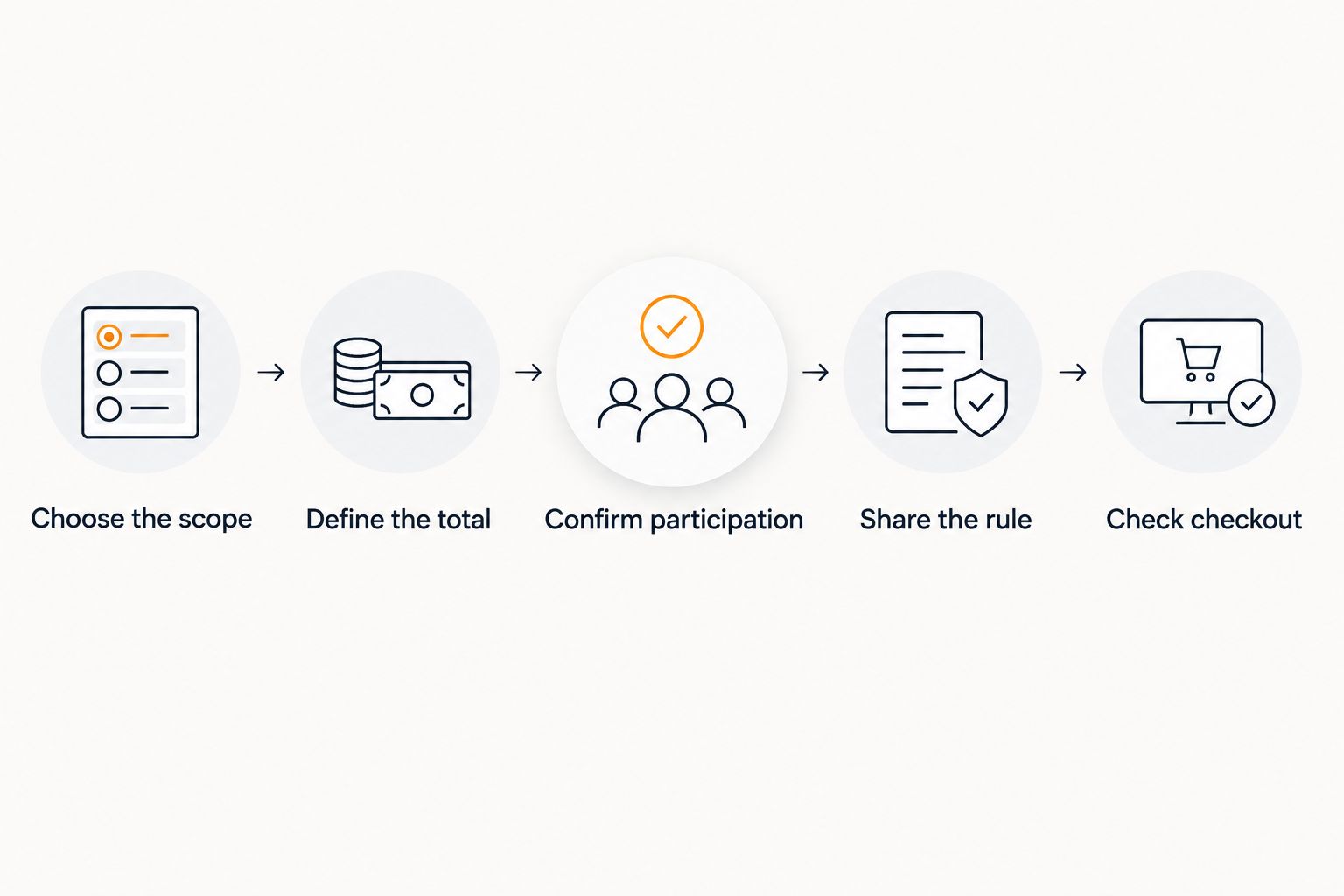
Use this sequence whether you coordinate through messages or an exchange organizer. The goal is a rule that answers the buyer’s questions before checkout, not a long list of exceptions.
- Choose the scope. Decide whether the cap covers each giver’s total purchase or the entire group’s shared gift. State whether multiple items for the same recipient count together.
- Define the total. Say whether tax, delivery, wrapping, and other purchase-related expenses sit inside the limit. An all-in cap keeps the rule tied to what the buyer actually pays.
- Confirm participation. Ask people to agree to the budget before making assignments or arranging a shared purchase. Give them a straightforward way to opt out.
- Share the rule. Put the budget in the message people use to join or find the list. If your organizer supports a budget setting, use it as well.
- Check checkout. Ask the buyer to compare the final payable total with the agreed cap. The item’s displayed price alone does not answer that question.
The sequence matters. Sharing a list before defining the spending rule leaves buyers to interpret what the group expects.
For your 2026 invitation, keep the spending rule beside the exchange date and joining instructions. If you discuss a change later, share the updated agreement with everyone rather than relying on a private conversation with one buyer.
Individual exchanges: cap each giver’s total purchase
An individual exchange needs a per-giver rule. Specify whether someone can buy several small items, and make clear that those items count together toward the same cap.
Best for: groups where each participant gives a gift to an assigned recipient. The advantage is a simple purchasing responsibility: each giver manages their own gift. The limitation is that the host cannot use a stated budget to control what a guest pays elsewhere.
LMK’s gift-exchange organizer lets a signed-in host set a budget and date, then share one invitation link through their own texts, WhatsApp, or email. Guests join with a first name without an account or download, and individual cross-store wishlists attach to the exchange.
LMK is best for gift-exchange groups that want a shared budget setting and cross-store wishlists without guest accounts. Its budget is a planning feature, not a checkout restriction.
For Secret Santa, the host cannot see other people’s name assignments. The guide to organizing a Secret Santa exchange online covers the separate task of arranging the draw; agreeing on spending belongs alongside that setup, not after shopping begins.
Shared gifts: separate the total from each contribution
A shared gift has two different budget questions: what the whole purchase can cost, and what each person has agreed to contribute. Write down both before anyone places the order.
Best for: friends, relatives, or colleagues buying a present together. The advantage is that contributions support one agreed purchase. The limitation is that a gift list does not, by itself, settle who collects money, places the order, or handles any remaining expense.
Choose a buyer and confirm the contribution agreement directly. If people are contributing different amounts, do not describe the plan as an equal split.
For a 2026 shared-gift plan, use the same all-in definition for the purchase ceiling and the contributions. If the final total exceeds what participants agreed to cover, choose a different gift or ask for fresh agreement before buying.
Never assume the person placing the order has agreed to cover the difference. That is a separate decision, not a consequence of being the designated buyer.
Wishlist budgets: offer choices without creating a minimum
A recipient can make a spending limit easier to follow by including suitable choices. The useful question is not whether every item fits the cap forever, but whether buyers have options that fit when they are ready to purchase.
Best for: recipients who want to give buyers guidance while leaving the final choice open. The advantage is flexibility across stores and gift ideas. The limitation is that a wishlist item’s current cost can change, so buyers still need to check the purchase total.
LMK supports wishlists from hundreds of stores and automatic price-drop alerts. Those features help buyers keep gift ideas together and notice a decrease; an alert does not guarantee that the final checkout total fits the group’s limit.
If you are combining ideas from different retailers, follow the cross-store gift list workflow. Keep the budget rule in the group’s message so the same instruction applies whichever store a buyer chooses.
Remove any suggestion that a giver must stretch their budget to satisfy the list. A suitable alternative is better than an uncomfortable purchase.
Why the meaning of a spending limit varies
The spending limit needs a definition because several different decisions sit behind it. Resolve these before calling the budget final:
- Exchange format: an assigned-recipient exchange and a shared purchase need different budget scopes.
- Purchase scope: a cap can cover a single item or all the items a giver buys for the recipient.
- Additional expenses: tax, delivery, and wrapping need an explicit place inside or outside the limit.
- Store selection: cross-store gift ideas leave buyers choosing where to complete the purchase.
- Purchase timing: price changes mean a saved item needs another check when the buyer is ready to order.
- Contribution agreement: a shared gift needs separate clarity about the overall ceiling and each contributor’s commitment.
Define the limit by the buyer’s agreed responsibility, not just by the item on the list. That distinction keeps a shared gift budget from being mistaken for a per-person allowance.
Does setting a budget stop guests from overspending?
A budget setting does not enforce the spending limit at checkout. Buyers remain responsible for following the group’s rule when they purchase from a retailer.
For your 2026 exchange, ask each buyer to check the final payable total. Do not promise that the organizer will reject an over-budget purchase or warn the host about one.
Should tax and delivery count toward the spending limit?
An all-in spending limit includes tax and delivery when the group defines it that way. Recommend that approach if your priority is keeping the buyer’s total expense within the agreed maximum.
If the group instead chooses an item-only cap, say so explicitly. Do not leave the buyer to discover at checkout that the group meant a different total.
Can price-drop alerts help a gift fit the budget?
Price-drop alerts can help a buyer notice a lower item price, but they do not enforce a spending limit. Check the retailer’s current checkout total before deciding that the gift fits.
The guide to wishlist price-drop notifications explains the alert workflow. Keep the spending decision separate: a decrease is useful information, not permission to exceed the cap.
What should you send with the invitation?
Send the exchange date, the spending rule, what the rule includes, and the joining link together. Add a short instruction about gift choices: buyers can choose an appropriate alternative rather than purchase a particular wishlist item.
For White Elephant, also share the group’s chosen game rules separately. Picking order, gift selection, and spending expectations are distinct parts of the plan; recording a budget does not enforce the game’s rules.
If you need help with that format, use the guide to organizing a White Elephant exchange online. Make the spending agreement clear before the event, rather than trying to resolve different interpretations while gifts are being opened.
FAQ
Can you set a spending limit on a group gift list?
Yes, you can agree on a maximum and share it with the group; a gift-exchange organizer can also support a budget setting. A stated budget does not stop a buyer from exceeding it at a retailer’s checkout.
Does LMK enforce the gift-exchange budget?
No, LMK’s gift-exchange budget is a planning setting, not checkout enforcement. The host can set a budget and date, but buyers must follow the agreed spending rule themselves.
Is a group gift budget per person or for the whole gift?
It depends on the agreement: an individual exchange needs a per-giver cap, while a shared gift needs an overall purchase ceiling and contribution agreement. State which applies before anyone buys.
Should shipping and tax be included in a gift budget?
Include shipping and tax if you want the limit to cover the buyer’s total expense. Tell participants explicitly whether the budget is all-in or item-only.
Can I buy several items within the spending limit?
Yes, if the group’s rule allows several items and their combined cost fits the agreed cap. Clarify whether purchase-related expenses count toward that total.
Does a shared wishlist collect money for a group gift?
A shared wishlist does not establish that money collection is included. Confirm any payment capability separately, and agree on who collects contributions and places the order.
What should I do if a wishlist item goes over budget?
Choose another suitable gift or ask the group to reconsider the agreement before buying. A recipient’s wishlist is guidance, not a requirement to exceed your spending limit.
One last thing
Call it a maximum, not a target. Tell participants that spending less is acceptable and that nobody needs to match another giver’s purchase.
For a 2026 exchange, put that reassurance in the original invitation. A clear spending ceiling works better when people know they have permission to stay comfortably below it.