How do you organize gifts for a retirement party?
Learn how to organize gifts for a retirement party: choose a coordinator, keep contributions optional, avoid duplicate gifts, and plan the final handoff.

To organize gifts for a retirement party, appoint a gift coordinator, confirm the retiree’s preferences, choose a group gift or individual gifts, and give guests clear purchase and delivery instructions. Keep contributions optional, track purchases separately from ideas, and assign someone to handle the presentation and take gifts home afterward.
- How to organize gifts for a retirement party: choose a coordinator, confirm preferences, and track purchases in one place.
- A group gift suits coordinated teams; individual gifts give guests more choice but need duplicate checks.
- LMK is best for retirement gift wishlists that combine items from different stores.
- Keep contributions optional and confirm who will transport gifts after the party.
Why this matters
A retirement gift needs a clear owner from suggestion through handoff. Without that, guests can discuss an idea without anyone actually buying it, or several people can buy the same thing. A short written plan separates suggestions, commitments, and completed purchases.
If coworkers want to pool contributions, settle the payment arrangements before shopping. This guide to splitting the cost of a gift with a group covers that part of the decision.
How do you organize gifts for a retirement party?
Choose the gift format first, then give every purchase a named owner. For your 2026 retirement party, use the following sequence rather than collecting ideas across separate messages.
1. Appoint a coordinator
Choose someone who can answer gift questions and keep the plan current. That person does not need to fund the gift or host the party; their job is to make sure decisions become completed tasks.
Name a backup if the coordinator will be busy running the event. Tell guests whom to contact privately about contributions, delivery problems, or a gift they have already bought.
2. Confirm preferences
Ask whether the retiree wants gifts, would welcome a shared present, or would prefer messages and memories. If the party is a surprise, ask someone close to them for guidance without circulating personal details to the whole group.
Check practical preferences too: space at home, hobbies they actually pursue, and whether they want an experience rather than an object. Do not turn a passing comment about travel or gardening into a purchase commitment.
3. Choose the format
Decide whether guests will contribute toward a shared gift, bring individual presents, or help create a memory collection. You can combine formats, but explain which part is organized and which part is optional.
For example, a team can coordinate a shared present while inviting everyone to submit a message. That does not require every guest to contribute money or arrive with something wrapped.
4. Share the instructions
Send a short note containing the gift plan, coordinator’s name, relevant deadlines, and delivery instructions. State plainly that participation is optional, especially when managers and direct reports are in the same group.
Set 2 deadlines: one for contributions or purchase commitments, and another for delivery. Choose both around the actual event and the selected gift’s requirements; do not assume every purchase needs the same lead time.
5. Track purchases
Keep a shared record of gift ideas and confirmed purchases, with financial details held privately. For each coordinated purchase, record the item, buyer, current status, and where it will arrive.
Assign 1 buyer to each shared gift. A group agreement to buy something is not a completed order, and an order confirmation is not proof that the item has arrived.
6. Prepare the presentation
Choose who will introduce the gift, who will hand it over, and where it will wait before the presentation. Keep the receipt or order details separate from the wrapped present and accessible to the coordinator.
Ask whether the retiree wants to open presents publicly. A brief acknowledgment can respect someone who dislikes attention without making guests feel their contributions disappeared.
7. Arrange the handoff
Assign someone to gather cards, loose accessories, and gifts after the event. Confirm the retiree has a way to transport everything before guests leave.
For shipped purchases, agree on 1 delivery address for coordinated orders unless there is a clear reason to use several. Get permission before sharing an address, and avoid putting it in an open invitation.
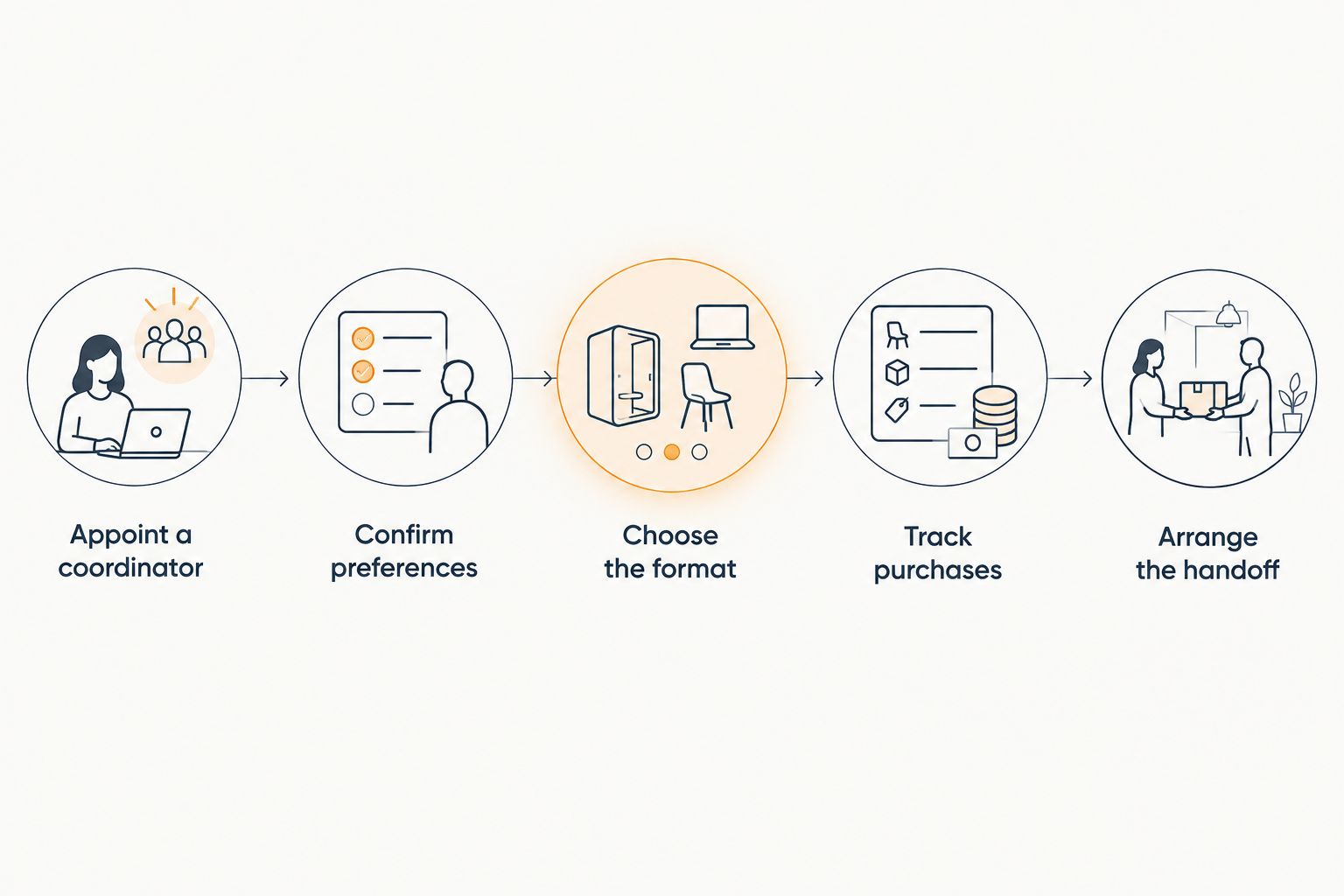
The sequence is simple: appoint a coordinator, confirm preferences, choose the format, track purchases, and arrange the handoff. Finish each decision before treating the gift plan as settled.
Which retirement gift format should you choose?
Match the format to the retiree’s wishes and the group’s ability to coordinate. Do not choose a pooled gift simply because collecting money sounds easier than collecting ideas. Someone still needs to manage contributions, purchase the gift, and resolve changes.
| Gift format | Best for | Advantage | Trade-off |
|---|---|---|---|
| Shared group gift | Teams that agree on a specific present | Gives one buyer a clear purchase to manage | Requires private contribution tracking and a fallback plan |
| Individual gifts | Guests with different relationships to the retiree | Leaves each guest in control of their choice | Requires coordination to reduce duplicate purchases |
| Memory collection | Groups that want to recognize shared experiences | Includes people who prefer not to contribute money | Requires someone to gather and assemble submissions |
Shared group gift: best for a coordinated team
Choose the gift before requesting contributions, or explain how the final choice will be made. Tell participants what happens if contributions do not cover the intended purchase or exceed what is needed.
Keep individual contribution amounts private. Do not circulate a payment leaderboard or ask a manager to chase employees who have not participated.
The advantage is a focused plan with a named buyer. The limitation is administrative: the coordinator must reconcile payments, communicate changes, and keep the purchase record.
Individual gifts: best for personal relationships
Use a short list of the retiree’s actual preferences to guide guests without prescribing identical purchases. Ask buyers to tell the coordinator what they have chosen before ordering.
This format leaves room for a colleague’s work-related keepsake or a friend’s more personal choice. Its limitation is overlap, so record the specific item rather than a broad label such as gardening gift.
Memory collection: best for shared stories
Invite guests to contribute a note, photograph they have permission to share, or a specific memory. Give submissions a clear destination and name the person responsible for assembling them.
A memory collection avoids making financial participation the center of the celebration. Its limitation is preparation: scattered messages still need editing, organizing, and a final presentation format.
Why retirement gift planning varies
There is no single gift plan that fits every retirement party. Use these factors to decide how much coordination your 2026 celebration needs:
- The retiree’s wishes. A request for no gifts takes priority over a team’s enthusiasm for a surprise purchase.
- The guest mix. Coworkers, relatives, clients, and friends do not share the same relationship or contribution expectations.
- The party location. A workplace reception and a restaurant gathering need different storage and handoff arrangements.
- The chosen gift. Personalization, recipient preferences, and delivery requirements affect when you must decide.
- The surprise level. A surprise limits direct questions, so appoint someone who can verify preferences discreetly.
- Workplace requirements. For an office celebration, check applicable employer rules before collecting money or accepting gifts from outside contacts.
Make these decisions before sending instructions. Changing the format after people have bought gifts creates work that a clear initial message avoids.
How should you track retirement gifts in 2026?
Separate the retiree’s wishlist from the coordinator’s administrative record. The wishlist explains what someone wants; the record explains who is buying it, whether it has arrived, and what still needs attention.
LMK is best for retirement gift wishlists that combine items from different stores. It supports items from hundreds of stores and automatic price-drop alerts, so gift ideas do not have to stay inside a single retailer’s list.
Use LMK for the cross-store wishlist, then maintain a separate record for contributions and purchase ownership. Price-drop alerts support shopping; they do not establish who has paid, ordered, or received a gift.
For a closer look at the category, see the guide to retirement gift list apps. Choose around the tasks you need to complete, not the length of a feature list.
Your coordinator’s record should contain:
- Gift description: the exact item or agreed experience, including relevant preferences.
- Purchase owner: the person responsible for placing the order.
- Status: suggested, assigned, ordered, received, or handed over.
- Delivery plan: the agreed destination and person receiving it.
- Receipt location: where the buyer keeps order and return information.
Keep private financial details out of a broadly shared list. If several people need visibility, share purchase status rather than everyone’s contribution amounts.
How do you keep retirement gifts a surprise?
Keep purchase coordination in a separate conversation from any list the retiree can access. Ask guests not to post order screenshots or delivery details in the party’s main group chat.
Do not assume a wishlist hides purchase activity. Before using any tool for a surprise, check its actual visibility settings; this guide to hiding purchased items from a gift recipient explains the question to resolve.
For a surprise party in 2026, also check where packages and notifications will appear. Use a delivery destination agreed with its recipient rather than sending an unexpected parcel to the retiree’s home or desk.
What should you tell guests about retirement gifts?
Give guests instructions they can act on without asking follow-up questions. Include the gift format, whether participation is optional, how to confirm a purchase, and where gifts should go.
Keep the message short and avoid publishing contribution amounts beside guests’ names. If someone asks privately what to spend, explain the group’s plan without turning a voluntary contribution into an obligation.
Before sending your 2026 invitation, check that the gift note answers these questions:
- Is there a coordinated gift, or should guests choose independently?
- Who answers questions and records purchases?
- When must guests confirm participation or deliver an item?
- Should gifts arrive wrapped, shipped elsewhere, or brought to the party?
- What should guests do if they prefer to contribute a message instead?
For pooled gifts, distinguish a suggested contribution from an enforced limit. The guide to setting a spending limit on a group gift list addresses that distinction.
How do you avoid duplicate retirement gifts?
Confirm purchase ownership before anyone orders. A gift appearing on an ideas list does not mean someone has claimed it, and a guest discussing an item does not mean they have bought it.
Record enough detail to distinguish similar choices. If someone selects a book, record the title and edition; if they choose an experience, confirm the recipient requirements before another guest buys something overlapping.
A wishlist helps communicate preferences, but duplicate prevention also needs a purchase-checking habit. This explanation of whether a wishlist app can prevent duplicate gifts helps separate list features from organizer responsibilities.
FAQ
What's the easiest way to organize gifts for a retirement party?
Appoint a coordinator, choose the gift format, and assign a named buyer to each coordinated purchase. Give guests clear deadlines and delivery instructions, then confirm that gifts have arrived before the celebration.
Should everyone contribute to a retirement gift?
Retirement gift contributions should be optional. Keep individual amounts private and offer a way to participate through a card or shared memory instead.
Is a group gift better than individual retirement gifts?
A group gift is better for a team that agrees on a specific present and has someone willing to manage it. Individual gifts give guests more choice but require purchase coordination to reduce duplicates.
Can I use LMK for a retirement gift wishlist?
LMK supports a retirement gift wishlist with items from hundreds of stores and automatic price-drop alerts. Keep a separate administrative record for contribution amounts, purchase owners, and delivery status.
How do I organize retirement gifts without spoiling the surprise?
Keep purchase coordination separate from conversations or lists the retiree can access. Check notification and visibility settings rather than assuming that purchases stay hidden.
What if the retiree asks for no gifts?
Respect the retiree’s request for no gifts. Ask whether they would welcome cards or shared memories instead, and do not replace an unwanted present with an unwanted public presentation.
What should I check before the retirement party starts?
Confirm that the gifts have arrived, the presenter knows the plan, and someone will handle transport afterward. Keep cards together and make sure the buyer can find receipts or order details if needed.
One last thing
Plan the trip home, not just the gift presentation. A thoughtful gift still needs someone to carry it, store it, and keep its accessories and paperwork together.
Before the 2026 party starts, confirm the final handoff with the retiree or a trusted contact. That small decision closes the gap between giving a gift and leaving someone responsible for an unexpected logistical task.