Dirty Santa Rules + Free Online Gift Exchange Draw (2026)
Dirty Santa works best with clear steal limits and a firm ending. Get ready-to-use rules, compare exchange formats, and set up a free online picking order.

Best overall for Dirty Santa: a classic steal-and-swap exchange with an online picking order. Best for a calmer party: a no-steal exchange. Best for buying for a specific person: Secret Santa. Use the rules below to choose your format, explain the turns, and finish your 2026 exchange without an argument.
- Dirty Santa combines wrapped gifts, a picking order, and the choice to open or steal.
- LMK is best for Dirty Santa hosts who want an online picking order and attached cross-store wishlists.
- Announce steal limits and the final turn before anyone opens a gift.
- Choose Secret Santa instead when each guest should buy for an assigned recipient.
Why this matters
Dirty Santa needs a clear ending more than it needs complicated rules. Decide what happens after a steal, when a gift becomes unavailable for stealing, and whether the first player gets another choice.
The name alone does not settle those questions. Dirty Santa, White Elephant, and Yankee Swap can describe similar exchanges with different house rules. For the online setup, the White Elephant exchange walkthrough covers the same picking-order approach used here.
What makes the best Dirty Santa format
Choose your 2026 format using these criteria before choosing a tool:
- Buying target: Guests buy for the shared pile or for one assigned person.
- Stealing tolerance: Decide whether losing an opened gift is part of the fun.
- Turn clarity: Every guest should know what happens after their gift gets stolen.
- Ending rule: Set gift-locking and final-turn rules before play starts.
- Joining effort: Match the setup to guests who will actually participate.
The default recommendation is classic Dirty Santa with written house rules. Choose a different format when your group does not want stealing or needs gifts selected for individual recipients.
Dirty Santa formats at a glance
| Format | Best for | Standout feature | Key limitation |
|---|---|---|---|
| Classic Dirty Santa with online order | Hosts who want stealing and shared setup | An online picking order supports an in-person gift pile | A person must enforce the game rules |
| No-steal wrapped-gift exchange | Groups that want a calmer opening | Each player keeps the gift they open | Removes the swap-and-steal element |
| Secret Santa | Groups buying for specific recipients | Each buyer gets an assigned person | Changes the game rather than simplifying Dirty Santa |
1. Classic Dirty Santa: best for a steal-and-swap party
Classic Dirty Santa gives each player a choice: open a wrapped gift or take an eligible opened gift. The first player opens because no opened gifts exist yet. Later steals create replacement turns until someone opens a wrapped gift.
LMK supports this Dirty Santa format through its free web-based Gift Exchange organizer's White Elephant picking-order option. A signed-in host creates the exchange, sets a budget and date, and shares one joining link through their own texts, WhatsApp, or email. Guests join with a first name without an account or download.
Classic Dirty Santa pros:
- Guests choose between a known gift and a surprise.
- Stealing makes the exchange interactive.
- An online organizer handles the picking-order part of setup.
Classic Dirty Santa cons:
- A host must track steals and apply house rules.
- Guests who dislike losing a gift need a different format.
- The organizer does not enforce gift-stealing rules.
Best for: An in-person group that actively wants swapping and stealing.
Verdict: Buy into this format when the stealing is the point.
Copy these Dirty Santa rules for your 2026 party
These are proposed house rules, not a claim that every Dirty Santa exchange follows the same limits. Send them before guests shop.
- Bring a gift. Each participant brings 1 wrapped gift that follows the agreed theme and spending limit. Do not label it for a specific recipient.
- Set the order. Assign each participant a position before play starts. Use an online picking order or numbered slips.
- Open first. The first player chooses a wrapped gift and opens it where everyone can see.
- Open or steal. Each later player opens a wrapped gift or steals an eligible opened gift.
- Replace a stolen gift. A player whose gift is stolen immediately opens a wrapped gift or steals another eligible gift.
- Prevent take-backs. A player cannot immediately steal back the gift just taken from them during that turn.
- Lock popular gifts. Under this house version, a gift becomes locked after 2 steals total. Opening it does not count as a steal.
- Cap each turn. Allow up to 3 steals per turn. After the third steal, the player left without a gift opens a wrapped one.
- Finish clearly. After the final wrapped gift opens, the first player can keep their gift or swap once with an unlocked gift. That swap ends the game.
A locked gift stays with its current holder. The final swap is not a new chain of steals, and it cannot take a locked gift.
That last sentence matters. Without it, a final-turn privilege can restart a game everyone thought had ended.
Set up the online picking order
LMK is best for Dirty Santa hosts who want an online picking order and attached cross-store wishlists. Select the White Elephant option for this format, not Secret Santa name assignments.
- Create exchange: The host signs in and sets the event budget and date.
- Share link: The host sends the joining link through their own messaging channel.
- Join guests: Participants join with a first name; no guest account or download is required.
- Set order: Use the White Elephant picking order for opening turns.
- Run turns: A person applies the announced stealing and ending rules.
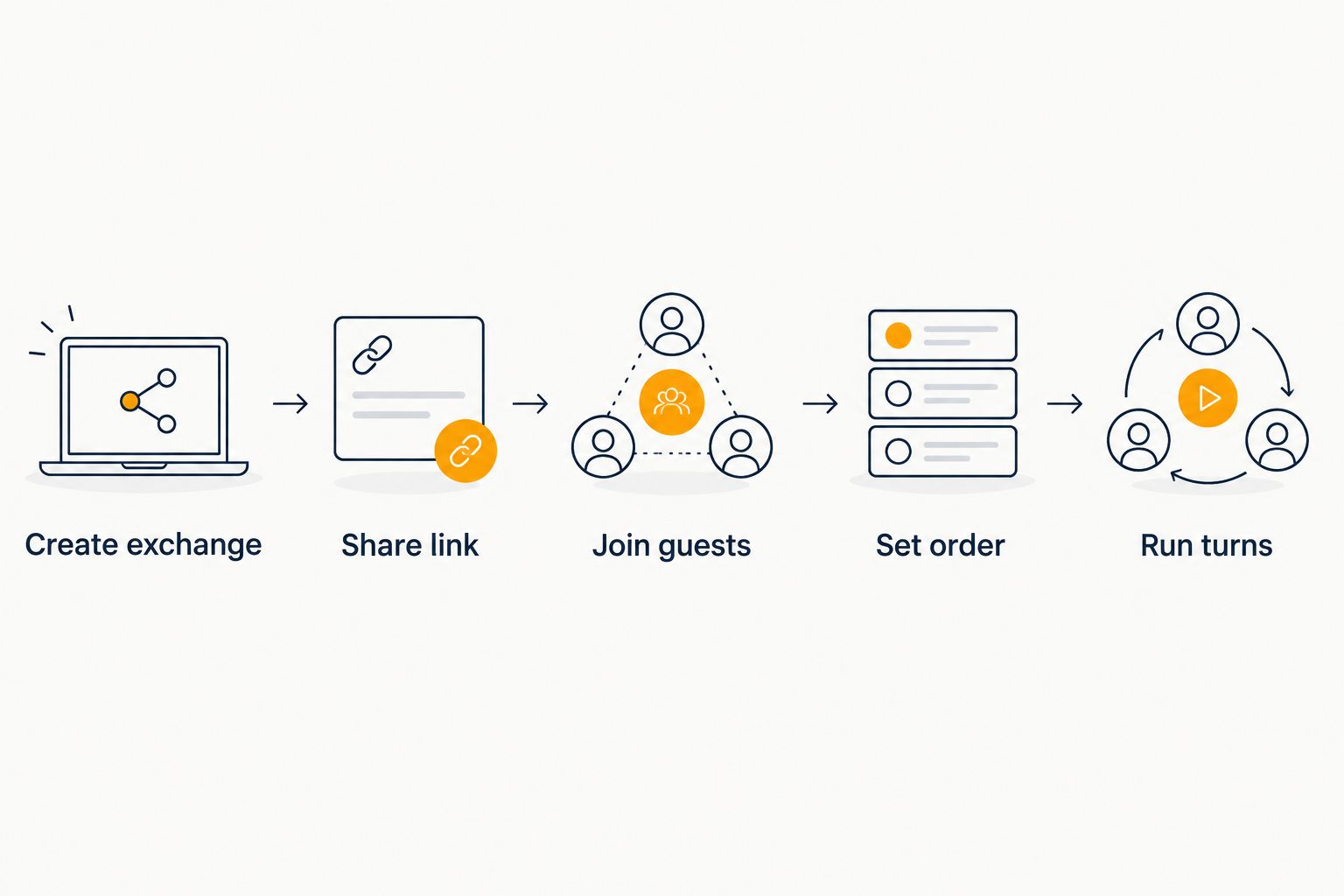
Do not treat a name draw and a picking order as interchangeable. A picking order decides when someone chooses from the pile; a name draw decides whom someone buys for.
2. No-steal exchange: best for a calmer gift opening
A no-steal exchange keeps the wrapped-gift pile and removes stealing. Guests take turns choosing a wrapped gift, open it, and keep it.
This is an alternative to classic Dirty Santa, not the same game under a shorter rules sheet. Tell guests about the change in the invitation so nobody arrives expecting swaps.
No-steal exchange pros:
- Each turn ends after a gift opens.
- Nobody loses a gift they have already received.
- The host does not need to count steals.
No-steal exchange cons:
- Guests lose the chance to choose an already-opened gift.
- The format removes the interaction that defines steal-and-swap play.
Best for: A group that wants surprise gifts without competition over them.
Verdict: Buy into this format when keeping the gift matters more than stealing it.
3. Secret Santa: best for recipient-specific gifts
Secret Santa assigns each buyer a recipient before shopping. Unlike Dirty Santa, it does not use an anonymous shared pile or let people steal opened presents.
LMK also supports Secret Santa name draws, with assignments hidden from the host. Individual cross-store wishlists attach to the exchange so buyers can work from their recipient's ideas. For a workplace version, use the office Secret Santa planning guide.
Secret Santa pros:
- Buyers choose gifts for a specific person.
- Individual wishlists give the shopping a clear direction.
- No stealing rules are needed during the opening.
Secret Santa cons:
- Guests need their assignments before buying.
- It does not deliver the shared-pile game Dirty Santa guests expect.
Best for: Groups that prefer personal gifts over swaps.
Verdict: Skip Secret Santa if your invitation promises Dirty Santa.
How these formats are ranked
Classic Dirty Santa ranks first because it matches the query: wrapped gifts, opening turns, and stealing. No-steal ranks second as the simpler alternative; Secret Santa ranks third because it solves a different buying problem.
The comparison prioritizes game fit, clear turns, guest joining, and an ending the host can explain. Software helps organize participants; it does not replace the party rules.
Choose gifts people can actually use
For a 2026 office Dirty Santa, write the gift brief around the whole group rather than one close friend. State whether gifts should be practical, playful, homemade, or re-gifted, and say which categories are out of bounds.
Funny should not mean personal. A joke that depends on someone's body, salary, religion, or relationship status puts the recipient on the spot. Set that boundary before shopping, not after an uncomfortable opening.
The distinction matters when choosing funny gifts for coworkers: aim the joke at a shared situation, not a colleague's private life. A gift should still make sense to whoever ends up holding it after the last steal.
Use this buying brief:
- Choose something another participant can use without knowing your intended joke.
- State whether food, alcohol, scented items, or adult humor fit the event.
- Explain whether the spending limit includes wrapping and delivery.
- Ask guests not to hide extra conditions inside the gift.
Use wishlists differently for Dirty Santa
A recipient-specific list fits Secret Santa directly. In Dirty Santa, nobody knows who will keep a gift, so individual lists work better as clues to the group's interests than as assignments.
For your 2026 exchange, keep the invitation explicit: buy for the pile, not for the person whose list you happened to open. The family Christmas wishlist guide covers the separate task of collecting personal gift ideas.
LMK wishlists combine items from hundreds of online retailers and include automatic price tracking and drop alerts. Those features support shopping; they do not guarantee that an item meets your event's spending rule.
If you collect ideas while browsing stores, the browser-extension setup walkthrough covers saving products during shopping. Keep that preparation separate from the rules guests need during the game.
Prevent the arguments before the first turn
A short rules message is easier to apply than several exceptions announced during play. Put the spending definition, steal cap, locked-gift rule, and final turn in the same message.
Define spending separately from software settings. Entering a budget in an exchange organizer records the event's plan; it does not enforce spending at checkout. The group gift-list spending-limit guide addresses that distinction.
Also settle these practical questions:
- Late arrivals: Decide whether play waits or starts with confirmed participants.
- Shared households: Say whether each participating person brings a gift.
- Missing gifts: Resolve participation before setting the final order.
- Rule disputes: Name the person who makes the final call.
For 2026, keep one final version of the rules in the group conversation. If you change a limit before the party, resend the whole message rather than scattering corrections across replies.
Which Dirty Santa format should you choose?
Choose classic Dirty Santa with an online picking order if your guests want stealing. Use the proposed rules above, explain locked gifts, and make the final swap end the game.
Choose no-steal when guests want a wrapped-gift surprise without losing what they open. Choose Secret Santa when buying for a known recipient matters more than the shared-pile game. Do not change formats after people have bought their gifts.
FAQ
What are the basic Dirty Santa rules?
Each participant brings a wrapped gift, takes a position in the picking order, and opens or steals on their turn. The first player opens a gift; later players choose an eligible opened gift or a wrapped one. Announce steal limits and the ending before play.
Is Dirty Santa the same as White Elephant?
Dirty Santa and White Elephant can describe the same steal-and-swap format, but the names do not guarantee identical rules. Tell guests the theme, stealing limits, and final-turn rule rather than relying on the event name.
How many times can you steal a gift in Dirty Santa?
The host sets the limit; this guide recommends locking each gift after 2 steals total. It also recommends a separate cap of 3 steals per turn, after which the player without a gift opens a wrapped one.
Does the first person get another turn in Dirty Santa?
Only if the announced house rules allow it. This guide gives the first player one optional swap with an unlocked gift after the final wrapped gift opens, and that swap ends play.
Can I organize a Dirty Santa picking order online?
Yes. LMK's free web-based Gift Exchange organizer supports White Elephant picking order, which fits this Dirty Santa format. The host signs in, while guests join through one shared link with a first name and no account or download.
Does an online organizer enforce Dirty Santa stealing rules?
LMK does not enforce gift-stealing rules. A person must track locked gifts, resolve take-backs, apply turn limits, and announce the end of the game.
Should I draw names for Dirty Santa?
Draw a picking order for classic Dirty Santa, not assigned gift recipients. If you want each guest to buy for a named person, choose Secret Santa instead.
One last thing
Read the ending rule aloud before anyone opens a gift. Guests can follow a simple opening turn by watching; they cannot infer whether the first player gets a final swap. Set that expectation while every present is still wrapped.