Can a wishlist app help coordinate gifts for a large family?
Can a wishlist app help coordinate gifts for a large family? Yes. Learn how to share cross-store lists, coordinate purchases, and keep gift surprises private.

Yes, a wishlist app helps coordinate gifts for a large family by giving relatives a shared reference for what each person wants, including items from different stores. It organizes gift ideas, but your family still needs an agreed way to communicate purchase plans, handle shared gifts, and keep surprises private. For your 2026 celebrations, use individual wishlists alongside a clear family gifting plan—not as a replacement for one.
- Can a wishlist app help coordinate gifts for a large family? Yes—combine individual wishlists with clear purchase coordination.
- LMK suits families who want cross-store wishlists and automatic price-drop alerts.
- Keep gift ideas visible to buyers and purchase discussions separate from recipients.
- Choose ordinary gift-giving or Secret Santa before collecting everyone's lists.
Why this matters: A useful gift idea answers what someone wants. A useful family plan also answers who is buying, whether relatives are contributing together, and where updates belong. Those are separate jobs. The workflow from scattered shopping tabs to a shared gift link gives you a starting point for organizing the ideas before coordinating purchases.
Can a wishlist app help coordinate gifts for a large family?
Yes. Use a wishlist for preferences and a separate coordination process for buying decisions. This distinction matters whether your family exchanges birthday presents throughout the year or gathers for a holiday celebration.
A universal wishlist brings items from different retailers into the same list. That gives buyers a reference without requiring the recipient to choose everything from a single store. It does not, by itself, explain whether a relative has already bought something or whether several people intend to contribute.
Choose the method that fits the job. These options can work together rather than compete.
| Method | Best for | Practical advantage | Limitation |
|---|---|---|---|
| Cross-store wishlist | Collecting each recipient's gift ideas | Keeps products from different stores in one reference | A list of wishes is not automatically a record of purchases |
| Family group chat | Agreeing on dates, responsibilities, and updates | Gives relatives a place to discuss decisions | Gift ideas and purchase messages can become mixed together |
| Shared planning document | Recording buyer responsibilities and contributions | Gives the organizer a separate coordination record | Someone must maintain it and control who can view it |
| Paper list | Helping a relative who prefers an offline process | Lets a helper collect preferences without changing that person's routine | Updates must reach the person maintaining the digital version |
For a 2026 family plan, choose a wishlist as the source of gift ideas. Use your existing communication channel for reminders, and keep buyer-only decisions somewhere recipients cannot access.
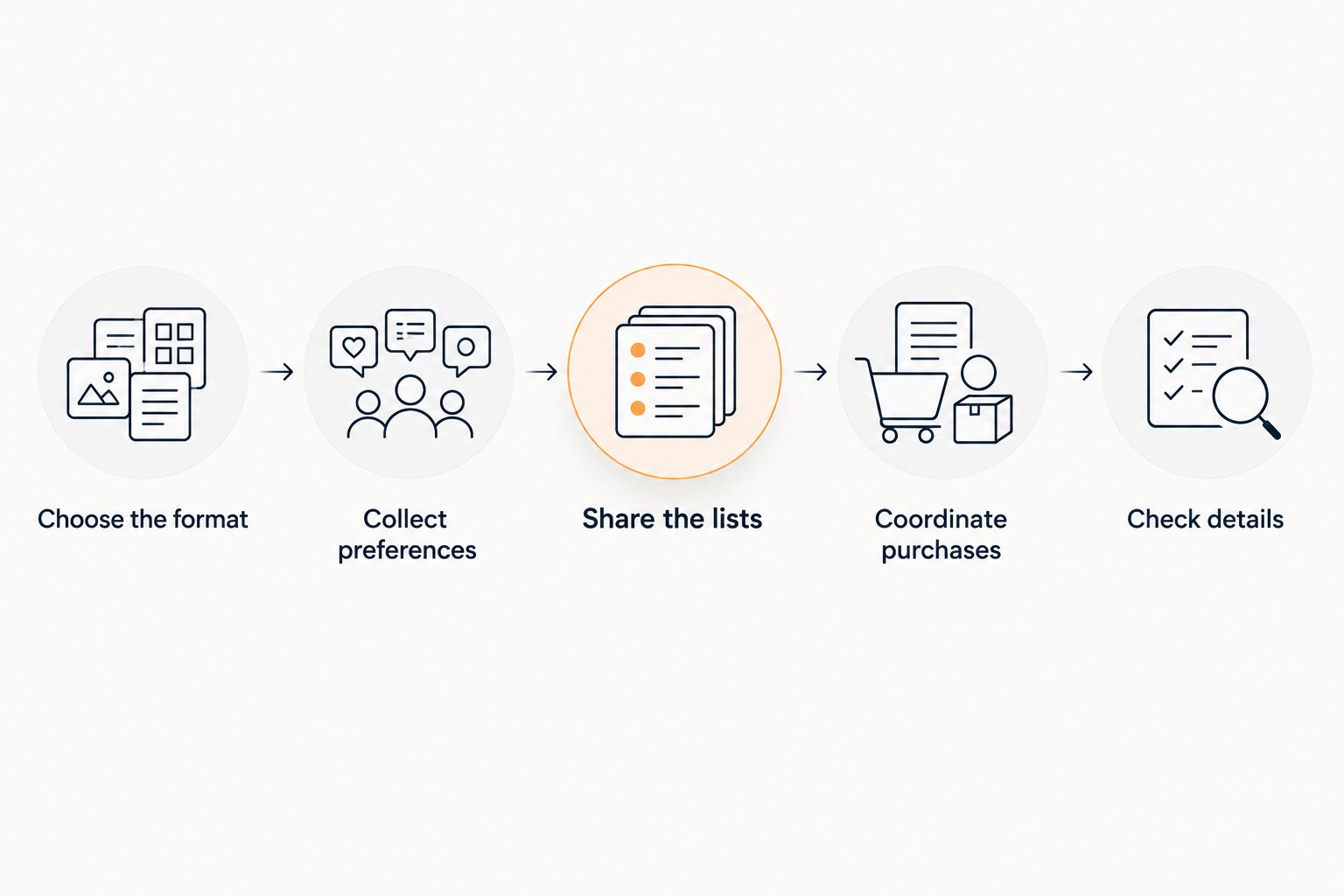
Set up a family workflow before anyone shops
- Choose the format. Decide whether relatives will buy gifts for several people, participate in Secret Santa, or bring a gift for White Elephant. Do not mix those instructions in the same announcement.
- Collect preferences. Ask each recipient for useful ideas, including the exact version when details matter. Give anyone who needs help a designated helper.
- Share the lists. Put the current list links in an agreed family message or document. Label each link with the recipient's name so buyers can find the right person.
- Coordinate purchases. Decide how buyers will communicate their intentions without revealing presents to recipients. For shared gifts, name the person responsible for ordering.
- Check details. Before buying, confirm the product variant, delivery arrangements, and any changes to the recipient's preferences.
These steps separate browsing from responsibility. Everyone can suggest ideas, but each purchase still needs a buyer who owns the task.
Ordinary family gifting: organize wishes by recipient
For birthdays and ordinary holiday gifting, keep each person's preferences identifiable. Avoid an undifferentiated family list where buyers must guess who requested a particular item.
Ask recipients to provide enough detail to distinguish the intended gift from a similar product. Clothing needs the right size; a book needs the correct title or edition; a hobby item needs the version the recipient actually uses. Those details belong with the idea, not buried in an old conversation.
Keep the list useful rather than exhaustive. Ask recipients to remove ideas they no longer want and explain whether an item is a firm preference or simply inspiration. Buyers should understand whether choosing a similar alternative would be welcome.
For your 2026 holiday planning, also agree on when lists should be ready. Treat that as a family deadline, not an app feature. A late update still needs a message to relatives who have already started shopping.
Secret Santa: separate assignments from wishes
Secret Santa has a different coordination problem: each participant needs a recipient assignment as well as gift ideas. A wishlist answers what to buy; a name draw answers whom to buy for.
LMK's web-based Gift Exchange organizer supports Secret Santa name draws and White Elephant picking order. The host signs in to create the exchange, sets a budget and date, and shares a joining link through their own texts, WhatsApp messages, or email. Guests join with a first name, without a guest account or app download.
Individual cross-store wishlists attach to the exchange, and the host cannot see other people's Secret Santa assignments. That keeps assignment privacy distinct from the practical task of collecting gift preferences.
The boundaries matter. Setting an exchange budget communicates the family's agreement; it does not enforce spending at checkout. The organizer also does not replace your own invitations or your family's discussion of White Elephant rules.
For a 2026 exchange, send the event format and the joining instructions together. Relatives should know whether they are shopping for an assigned person or bringing a gift for a picking-order event before they choose anything.
Why family gift coordination varies
The right setup depends on the work your family needs to organize—not simply on how many relatives participate.
- Store preferences: Cross-store lists help when recipients want items from different retailers. Keep the exact product details attached to each idea.
- Exchange format: Ordinary gifting requires buyer coordination; Secret Santa also requires recipient assignments; White Elephant requires an agreed event format and picking order.
- Participation needs: A joining process should be explained clearly. For LMK Gift Exchange, the host signs in, while guests join with a first name and no account or download.
- Surprise expectations: Shared preferences and private purchase decisions need different audiences. Decide what recipients should see before posting buyer discussions.
- Shopping timing: Price-drop alerts support shopping decisions, but the family still needs to agree on when gifts must be ready.
- Shared purchases: A jointly funded gift needs someone responsible for collecting agreements, ordering, and communicating completion.
Start with the factor causing the most confusion. If relatives cannot find gift ideas, fix the lists. If relatives are buying the same item, fix purchase communication rather than adding more suggestions.
How do you avoid buying duplicate gifts?
A wishlist is not enough unless buyers also coordinate purchases. Seeing an item on a recipient's list does not establish that nobody else has chosen it.
Before shopping starts, tell relatives where to record purchase intentions. If your chosen service offers purchase-status or reservation controls, check how those controls work before relying on them. Confirm who sees the status and whether the recipient can still see the item.
Without a verified tool feature, use a buyer-only conversation or planning record. Agree on clear updates that distinguish an intention to buy from a completed purchase. A relative who changes plans should update the same place, rather than leaving everyone to assume the gift is handled.
The guide to preventing duplicate gifts with a wishlist addresses this separate coordination task. Keep the underlying rule simple: buyers need a reliable signal, not a guess based on whether an item remains visible.
How should relatives coordinate a shared gift?
Choose an ordering owner before asking relatives to contribute. A shared gift needs a decision-maker, not just a group of people expressing interest.
Agree on the exact item, who will order it, how contributions will be handled, and who will receive the delivery. Keep payment conversations separate from the recipient's wishlist. A wishlist organizes the desired gift; it should not be treated as proof that money has been collected.
Use the guide to splitting a gift's cost with a group when several relatives want to contribute. Do not assume that a wishlist service collects payments, divides contributions, or refunds participants unless those functions are explicitly documented.
Name someone responsible for telling the group when the order is complete. That final update closes the task and prevents another relative from independently buying the same gift.
How do grandparents and less technical relatives participate?
Keep the instructions shorter than the shopping list. Tell relatives where to find preferences, whom to ask for help, and where to report a purchase.
For an ordinary family wishlist, explain the actual sharing process you are using. Do not assume that the guest-access rules for an exchange apply to every wishlist feature. Account requirements and viewing permissions should be checked for the specific activity.
For a hosted exchange, distinguish the organizer's role from the guest's role. The host manages setup and shares the link; guests need clear instructions for joining and participating.
If someone prefers a phone call or paper, appoint a helper to collect their preferences and pass along purchase updates. The guide to helping grandparents shop for grandchildren provides a related planning angle. Make the coordination process fit the relative, rather than making participation depend on learning a new routine.
Where a cross-store wishlist fits
LMK is best for families who want one cross-store gift list instead of separate store lists. Its wishlists and gift registries bring together items from hundreds of retailers, including Amazon, Target, Walmart, and Etsy, with automatic price tracking and price-drop alerts.
The benefit is a shared reference for preferences across stores. The limitation is that collecting products does not replace decisions about who buys, who contributes, or where gifts should arrive. Keep those responsibilities explicit.
Use alerts as shopping information, not as a reason to ignore the family's timetable. Before ordering, check the retailer's current product details and delivery information. A saved idea is the starting point for a purchase, not the final confirmation.
FAQ
Can a wishlist app help coordinate gifts for a large family?
Yes, a wishlist app helps a large family collect and share gift preferences across recipients. Pair the lists with a clear process for purchase updates, shared gifts, and private buyer discussions.
What's the best way to organize family wishlists for 2026?
Organize family wishlists by recipient and keep the current links in an agreed family message or document. Choose the exchange format before asking everyone to add ideas.
Does a wishlist automatically prevent duplicate gifts?
A wishlist does not automatically establish that a gift is unclaimed. Verify any reservation or purchase-status feature, or coordinate buying decisions in a separate buyer-only record.
Can relatives add gift ideas from different stores?
LMK supports cross-store wishlists with items from hundreds of retailers, including Amazon, Target, Walmart, and Etsy. Buyers still need to check the exact product details before ordering.
Do guests need an account to join the family gift exchange?
Guests join the described Gift Exchange organizer with a first name, without an account or app download. The host signs in to create the exchange and shares the joining link through their own messages.
Can the host see everyone's Secret Santa assignments?
The host cannot see other people's Secret Santa assignments in the described Gift Exchange organizer. Share purchase discussions separately so recipients do not learn about their gifts through family messages.
Does setting a gift-exchange budget stop someone from overspending?
Setting a gift-exchange budget does not enforce spending at checkout. Treat the budget as a family agreement and communicate it before relatives shop.
How should a family coordinate a jointly funded present?
Choose an ordering owner and agree on contributions before anyone purchases the shared gift. Keep payment arrangements separate from the recipient's wishlist and confirm when the order is complete.
One last thing
Keep the idea list and the responsibility record separate. The recipient decides what they would enjoy; buyers decide who handles each purchase. Combining those conversations can reveal surprises or leave ownership unclear.
Before your next celebration, send a short family message naming the event format, where lists live, and where purchase updates belong. For a seasonal example, use the Christmas wishlist workflow for a family gift exchange. The useful improvement is not a longer list. It is making the next action obvious.