How do you avoid getting duplicate baby shower gifts?
Learn how to avoid duplicate baby shower gifts with one shared registry, clear quantities, and a host who tracks outside purchases while keeping gifts a surprise.

To avoid duplicate baby shower gifts, share one current registry, list the quantities you actually need, and have buyers coordinate before purchasing. Ask a trusted host to track off-registry gifts and purchases from other stores, because a shared list alone does not tell everyone what has already been bought. Keep surprise details with the host rather than asking every guest to report purchases to you.
- How to avoid duplicate baby shower gifts: use one current registry, clear quantities, and buyer coordination.
- LMK suits parents who want a cross-store baby registry instead of scattered store links.
- Ask a trusted host to track off-registry gifts without revealing surprises to the parents.
- Price-drop alerts help with shopping; they do not replace purchase coordination.
Why this matters
A registry tells guests what you want; purchase coordination tells them what someone else has already chosen. You need both. Two guests can follow the same list correctly and still buy the same item if neither knows about the other purchase.
For a 2026 baby shower, make the buying instructions as easy to find as the gift list. The distinction explained in whether a wishlist can prevent duplicate gifts is the useful starting point: collecting ideas and coordinating purchases are separate jobs.
The goal is not to control every gift. It is to keep guests from spending time choosing something you already have, while leaving room for thoughtful surprises.
How do you avoid getting duplicate baby shower gifts?
Use this sequence before you send invitations, then keep the same process until the shower. Choose one list as the source of truth and one person to handle exceptions.
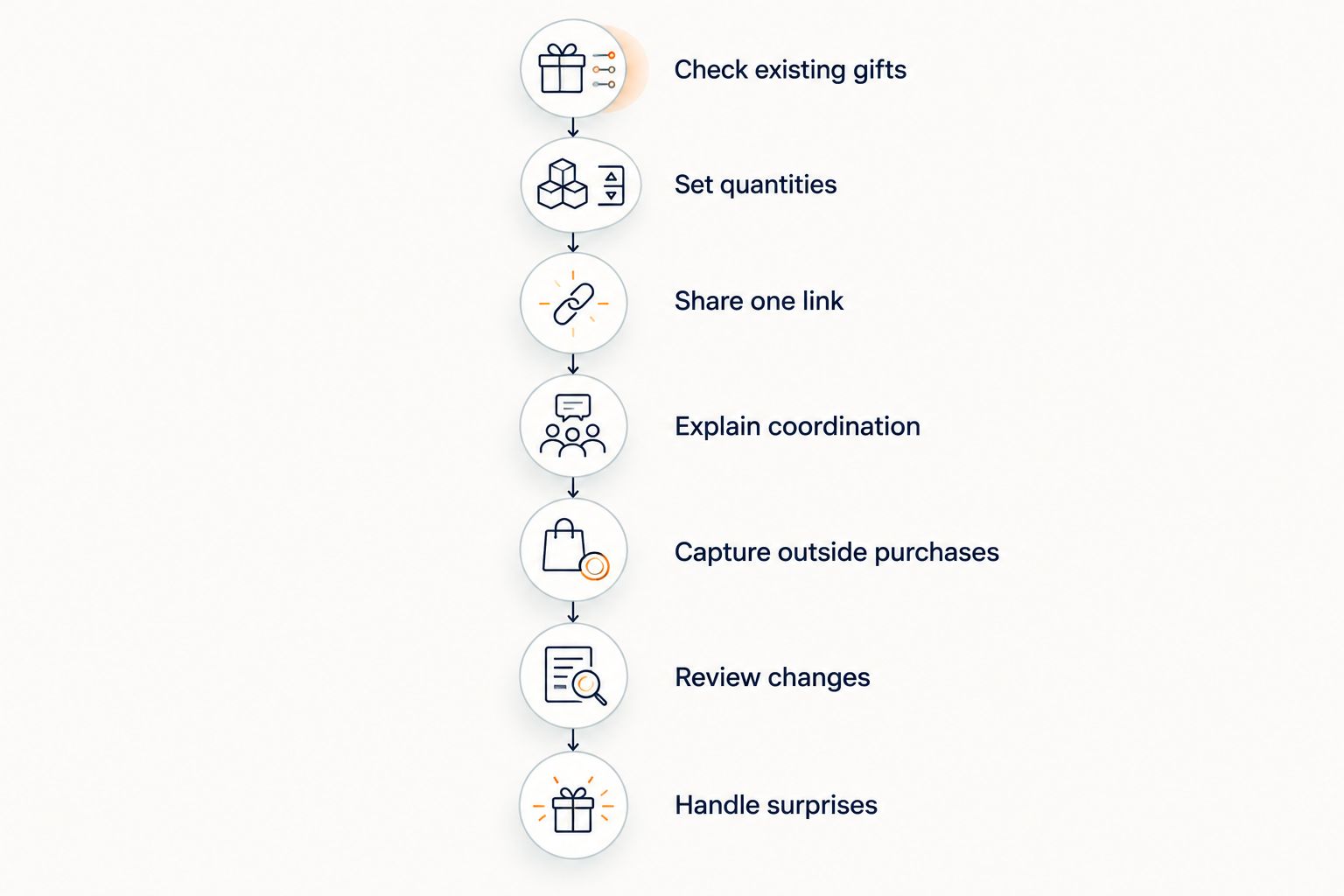
- Check existing gifts. Start with what you already own, including hand-me-downs, gifts received early, and items bought by family. Remove things you no longer need before anyone starts shopping. Tell the host about gifts promised privately so those commitments are not invisible to other buyers.
- Set quantities. Specify whether you want 1 item or several. A single entry without a quantity leaves guests guessing whether another purchase is helpful. Separate a deliberate request for multiples from an accidental repeat of the same product.
- Share one link. Put the same registry link in the invitation, reminder, and family message thread. Do not send one store list to relatives and a different list to friends unless both point back to the same coordinated record. Keep screenshots out of the buying instructions; they cannot reflect later changes.
- Explain coordination. Ask buyers to use the registry's purchase or reservation controls if those controls exist and work for your setup. Give them a host contact for purchases that cannot be recorded there. Keep the instruction short enough to read before checkout.
- Capture outside purchases. Ask guests buying elsewhere to tell the host the exact item and quantity. Buying from a different retailer does not create a different need. The host should record the gift against the requested item, not against the store that sold it.
- Review changes. Have the host check the list after receiving a purchase update, a cancellation, or an early gift. An abandoned plan should not block another guest from buying something still needed. A completed purchase should not remain presented as an unclaimed request.
- Handle surprises. Give guests a private way to ask about an unlisted gift. The host can confirm whether the family already has something similar without describing everything on the registry. Keep this route optional and welcoming, not another task every guest must complete.
The essential rule is simple: coordinate the item, not the retailer. If someone buys the requested baby carrier elsewhere, that purchase still needs to be accounted for against the original request.
Which registry setup should you use in 2026?
Choose your setup based on where the gifts come from and how buyers will report purchases. Do not choose solely on how neatly a list displays products. For duplicate prevention, the purchase-update process matters more than presentation.
| Setup | Best for | Useful part | Limitation to address |
|---|---|---|---|
| Cross-store registry | Parents requesting items from different retailers | Gives guests one place to find requests | Confirm how purchases made elsewhere are recorded |
| Separate store registries | Families keeping existing retailer lists | Keeps requests within each store's registry process | The same item needs coordination across lists |
| Host-managed gift record | Surprise gifts and purchases outside the registry | Gives buyers a person who can check for conflicts | The host must keep the record current |
A host-managed record can support either registry setup. It does not need to replace your registry; it handles the gifts and commitments the registry does not capture.
If you already have several retailer lists, combine store requests into one gift list before sharing your invitation. Review repeated entries during consolidation rather than carrying the same request into the new list twice.
LMK is best for parents who want a cross-store baby registry in one shared list. It lets shoppers collect items from hundreds of online retailers and provides automatic price tracking and price-drop alerts. Those shopping features support buyers; they do not replace a clear process for reporting purchases.
Use that distinction when assessing a baby registry wishlist app. Check how your chosen setup handles an outside purchase, a changed mind, and a request for multiple items before relying on it for the shower.
What if you already have separate store registries?
Pick a primary list and make its role explicit. Guests should know where to start, not have to compare several registries to decide which is current. Remove repeated requests from secondary lists or give the host responsibility for reconciling them.
An item sold by different retailers remains the same request. If you list the same model twice, do not assume guests will recognize the overlap from different photos or product titles. Match the model, version, and intended quantity yourself.
For your 2026 shower, also check older links in family chats. Send a short correction when a list has been replaced, and ask the host to direct later questions to the current version. Keeping old lists accessible without explanation creates competing instructions.
What if guests want to buy off-registry gifts?
Give guests a host contact, not a blanket ban on surprises. Ask them to check before buying something that serves the same purpose as a requested item. A different brand of the same kind of gift can still leave you with an unwanted duplicate.
The host only needs enough detail to spot a conflict. Record the item type, the intended quantity, and whether the guest is considering it or has bought it. Avoid collecting payment information or forwarding receipts through a group chat.
Make the distinction between a plan and a purchase clear. A guest exploring an idea has not necessarily committed to it. If plans change, the host should clear the old note so it does not keep another guest from choosing a useful gift.
What if you genuinely want several of the same item?
Multiple gifts are only duplicates when they exceed what you want. If you need several matching items, say so directly. Do not remove a request after the first purchase when you still want more.
Write the desired quantity beside the exact item rather than relying on guests to infer it. For clothing, include the requested size; for a set, clarify whether you mean one set or individual pieces. Those details help the host distinguish a useful addition from an unnecessary repeat.
Apply the same rule to gifts already received. If the original request was for 2 identical items and you receive 1 early, the remaining need is 1 item. Treat this as a planning example, not a reason to request multiples you do not need.
Why duplicate baby shower gifts happen
Duplicate gifts come from gaps between the request, the purchase, and the update. Look for these specific gaps when reviewing your list:
- Competing lists: Different guests receive different links, with no clear primary registry.
- Repeated requests: The same item appears under different retailer names or product photos.
- Unclear quantities: Guests cannot tell whether the family wants one item or several.
- Outside purchases: Someone buys the requested item elsewhere without notifying the host.
- Private commitments: A relative promises a gift, but nobody records that promise for coordination.
- Old information: Guests shop from screenshots or messages sent before a purchase update.
For a 2026 baby shower, address these gaps before adding more gift ideas. A shorter, current list is easier to coordinate than a longer list containing repeated or unclear requests.
How do you keep gifts a surprise while preventing duplicates?
Choose a trusted host to receive purchase details privately. The host can check conflicts and update the coordination record without sending the parents a list of buyers and gifts. This separates practical planning from the surprise itself.
Before sharing the registry, confirm exactly what the recipient and other guests can see. A product appearing on a wishlist does not establish whether purchase activity is hidden. Review how purchased items can be hidden from a gift recipient when choosing your process.
Keep address details separate from general gift coordination. Tell guests where delivery instructions belong, and check what appears when the link is opened by someone else. The guide to sharing an address on a gift registry covers the privacy question without making the public invitation carry every detail.
How do you tell guests to check before buying?
Put a brief instruction beside the registry link. Ask guests to check the current list before purchasing, record the purchase through the agreed process, and contact the host if they buy elsewhere. Avoid a long explanation of everything that could go wrong.
For a 2026 invitation, include the host's preferred contact method and explain that the host handles gift questions privately. Send that same instruction in reminders. Consistent wording is more useful than adding new rules in each message thread.
Keep the tone appreciative. Guests are choosing a gift, not completing an administrative assignment. Give them a direct next step and an easy fallback if the registry process is unclear.
What should the host track outside the registry?
Use a simple record with 3 statuses: considering, committed, and purchased. These are suggested planning labels, not software features. They prevent a tentative conversation from being treated as a completed gift.
For each entry, record the item, quantity, guest, and current status. Note whether it matches a registry request or adds something new. When the guest changes plans, update that entry rather than creating another disconnected note.
The host should check the record before answering a gift question. A record that nobody consults cannot resolve conflicts. Keep access limited to the people coordinating the shower so the process does not reveal surprises unnecessarily.
FAQ
What's the best way to avoid duplicate baby shower gifts?
Use one current registry, clear quantities, and a purchase-coordination process. Ask a trusted host to record gifts bought elsewhere and handle private gift questions.
Can a universal baby registry stop every duplicate gift?
A universal baby registry does not guarantee that every gift will be unique. Guests still need a way to report purchases, especially when buying outside the linked retailer.
Is LMK useful for a baby registry with items from different stores?
LMK is useful for parents building a cross-store baby registry. It collects items from hundreds of online retailers and offers automatic price tracking and price-drop alerts.
What should I do if someone buys a registry gift somewhere else?
Ask the buyer to report the exact item and quantity through your agreed coordination process. The host should account for it against the original request regardless of where it was bought.
How can I prevent duplicates without seeing my baby shower gifts?
Have a trusted host receive purchase details privately and handle conflicts. Confirm what your registry reveals to recipients before relying on it to preserve surprises.
Should I remove an item after someone buys it?
Update the remaining need after a purchase rather than automatically removing the request. Keep it on the list if you still want more, and remove or close it when the desired quantity is covered.
What should I do if I receive duplicate gifts anyway?
Check with the giver before arranging an exchange, and review the seller's current return terms. Update your list afterward so another guest does not buy an item you no longer need.
One last thing
Check for duplicate purposes, not just duplicate product names. Two different baby carriers can meet the same request, even though their listings look unrelated. Tell the host which gifts are alternatives and which are separate needs.
Before you share the link, remove overlapping choices you would not want together. Then make your final check from a guest's perspective: can someone tell what is needed, how to coordinate, and whom to ask? That is the useful test of your duplicate-prevention plan.